



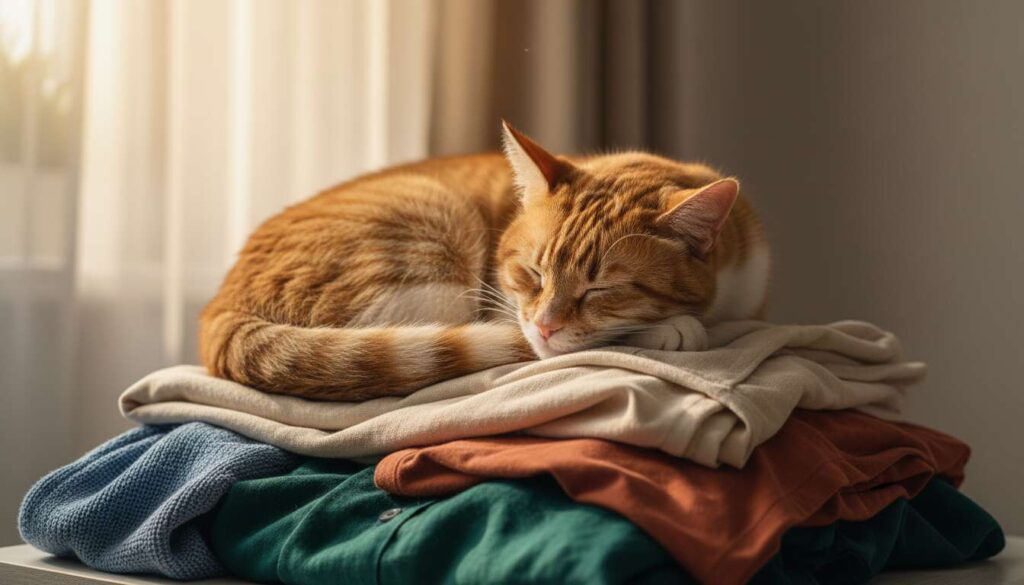
Discovering your cat curled up on your favourite jumper or nestled amongst your freshly laundered clothes might seem peculiar at first. Yet this behaviour is far from random. Feline behaviourists have identified several interconnected reasons that explain why cats develop this particular sleeping preference. From scent recognition to territorial instincts, understanding these motivations provides valuable insight into your pet’s emotional world and natural behaviours.
The link between feline behaviour and clothing
Natural instincts driving sleeping choices
Cats are highly selective creatures when it comes to choosing their resting spots. Their wild ancestors developed specific survival instincts that continue to influence domestic cats today. These instincts drive them towards locations that offer warmth, security, and strategic positioning within their environment. Your clothing naturally ticks many of these boxes, making it an attractive sleeping option.
Texture and temperature preferences
The physical properties of fabric play a significant role in this behaviour. Cats possess a higher body temperature than humans, typically ranging between 38 and 39 degrees Celsius, which means they actively seek warm surfaces. Your clothes retain body heat and offer:
- Soft, pliable textures that mould to their body shape
- Insulating properties that maintain warmth
- Varied fabric types that appeal to their tactile senses
- Elevated positions when clothes are piled on furniture
Behavioural patterns and routine
Felines are creatures of habit who develop routines around their daily activities. Once a cat discovers that your clothing provides comfort, they’re likely to return repeatedly to that spot. This pattern becomes reinforced through positive association, creating a habitual behaviour that can persist for years. The predictability of finding your clothes in certain locations also appeals to their need for environmental consistency.
Beyond mere physical comfort, however, there exists a deeper psychological dimension to this behaviour that relates directly to how cats process and respond to scent.
The importance of scent: when your odour becomes a haven
Olfactory communication in cats
A cat’s sense of smell is approximately fourteen times stronger than that of humans. They possess around 200 million scent receptors, making olfactory information crucial to how they interpret their world. Your personal scent is immediately recognisable to your cat and carries significant meaning. When they sleep on your clothes, they’re essentially surrounding themselves with your unique olfactory signature.
Scent as a source of comfort
Your smell represents familiarity and safety to your feline companion. Behaviourists have observed that cats particularly favour worn clothing over freshly laundered items precisely because the scent is stronger. This preference demonstrates that the behaviour is driven by emotional needs rather than simple comfort seeking. The table below illustrates the scent preference patterns observed in feline behaviour studies:
| Clothing type | Preference level | Primary attraction factor |
|---|---|---|
| Recently worn items | Very high | Strong human scent |
| Laundered but worn once | Moderate | Residual scent present |
| Freshly washed clothes | Low | Detergent scent predominates |
Absence and separation anxiety
When you’re away from home, your cat may seek out your clothes more frequently. This behaviour intensifies during periods of separation because your scent provides reassurance in your absence. Cats experiencing mild separation anxiety often display this compensatory behaviour, using your smell as a surrogate for your physical presence.
The reassuring qualities of scent work in conjunction with other psychological factors that make fabric surfaces particularly appealing to anxious or comfort-seeking cats.
Security reasons: why fabric is more reassuring than the bed
Enclosed spaces and vulnerability
In their natural habitat, cats seek protected locations for sleep where they’re less vulnerable to predators. Piles of clothing create small, enclosed spaces that mimic the secure dens their ancestors would have chosen. Unlike a flat bed surface, clothes offer:
- Concealment opportunities through draping fabric
- Multiple layers creating a nest-like environment
- Elevated positions on chairs or wardrobes
- Boundaries that define their sleeping space
Strategic positioning
Cats are tactical sleepers who consider their surroundings carefully. Your clothes are often located in bedrooms, wardrobes, or living areas where family activity occurs. This positioning allows them to rest whilst remaining aware of household movements. They can monitor comings and goings without being directly in the centre of activity, striking a balance between involvement and rest.
Stress reduction through familiar items
Environmental changes, new pets, or household disruptions can trigger stress responses in cats. During these periods, they may increasingly seek out your clothing as a coping mechanism. The combination of your scent, soft texture, and secure positioning creates a sanctuary where they can regulate their emotional state. Behaviourists note that this self-soothing behaviour is entirely normal and often temporary.
Whilst security needs drive cats towards your clothes, there’s also an element of ownership and territorial behaviour at play in their choice of sleeping location.
Territorial marking: your clothes, their domain
Scent glands and marking behaviour
Cats possess scent glands located on their faces, paws, and flanks. When they sleep on your clothes, they’re depositing their own scent through these glands. This process, known as bunting when done with the face, serves to mark items as part of their territory. The behaviour intensifies in multi-pet households where establishing ownership becomes more important.
Claiming resources
From a cat’s perspective, your clothes represent a valuable resource. By sleeping on them and marking them with their scent, they’re essentially claiming these items as part of their territory. This doesn’t indicate aggression or dominance issues; rather, it’s a normal aspect of feline social behaviour. They’re integrating your belongings into their mental map of owned spaces.
Mixed scent creation
When cats combine their scent with yours on clothing, they’re creating a communal scent profile. This blended smell represents the social group, which in a domestic setting includes you and your cat. Behaviourists interpret this as a bonding behaviour that reinforces the cat’s sense of belonging within your household. The process works both ways: you carry their scent, and they surround themselves with yours.
These territorial behaviours are closely intertwined with the emotional connections cats form with their human companions, revealing the depth of the human-feline relationship.
Understanding the emotional bond and attachment
Attachment styles in cats
Research into feline behaviour has revealed that cats form genuine attachment bonds with their owners, similar to those observed in dogs and human children. Sleeping on your clothes is one manifestation of this attachment. Cats with secure attachments use their owner’s belongings as a source of comfort, particularly when feeling vulnerable or during rest periods.
Trust and affection indicators
Choosing to sleep on your clothes demonstrates several positive aspects of your relationship:
- Trust in your presence and protection
- Comfort with your scent and proximity
- Desire for connection even during rest
- Recognition of you as a source of security
Individual personality differences
Not all cats display this behaviour with equal intensity. Personality variations play a significant role in how cats express their attachment. More independent cats might rarely sleep on clothes, whilst highly social or anxious individuals may seek out your garments regularly. Neither pattern indicates a problem; they simply reflect different temperamental approaches to expressing affection and seeking comfort.
Whilst this behaviour is generally harmless and even endearing, there are circumstances where management or intervention might be necessary.
Managing this behaviour: when and how to intervene
Assessing whether intervention is needed
Most instances of cats sleeping on clothes require no intervention whatsoever. However, you might consider addressing the behaviour if:
- Your cat refuses to sleep anywhere else
- The behaviour suddenly intensifies without apparent reason
- It’s accompanied by other concerning behaviours like excessive vocalisation
- You need to maintain clothing hygiene for professional or personal reasons
Practical management strategies
If you wish to redirect this behaviour, gradual and positive approaches work best. Consider creating alternative sleeping spaces that replicate the appealing qualities of your clothes. Place a worn t-shirt in a comfortable cat bed to transfer your scent. Ensure these alternative spots are located in secure, quiet areas where your cat feels safe.
Environmental enrichment approaches
Providing adequate mental and physical stimulation during waking hours can reduce excessive comfort-seeking behaviours. Interactive play sessions, puzzle feeders, and climbing structures help cats expend energy and feel more secure in their environment. A well-stimulated cat is less likely to develop compulsive comfort-seeking patterns.
When to consult a professional
If the behaviour seems excessive or is accompanied by signs of distress such as over-grooming, appetite changes, or aggression, consulting a veterinary behaviourist is advisable. These professionals can assess whether underlying anxiety or medical issues are contributing to the behaviour and recommend appropriate interventions.
Understanding why your cat sleeps on your clothes reveals the complex interplay between instinct, emotion, and environmental factors that shape feline behaviour. This seemingly simple habit reflects your cat’s need for warmth, security, and connection. Whether driven by your comforting scent, territorial instincts, or genuine affection, the behaviour demonstrates the sophisticated emotional world of cats. For most owners, accommodating this preference strengthens the bond with their feline companion whilst respecting their natural behavioural needs.