


Dogs communicate in ways that often leave their human companions wondering whether these loyal animals experience emotions similar to our own. When a dog leans against your leg after you’ve refilled their water bowl, or when they gently place a paw on your hand following a treat, many owners interpret these gestures as expressions of gratitude. The question of whether dogs can genuinely say “thank you” has intrigued pet owners and scientists alike, prompting deeper investigation into canine cognition and the sophisticated ways dogs interact with the humans they’ve bonded with over thousands of years of domestication.
Can dogs really say “thank you” ?
The concept of gratitude in dogs remains a subject of scientific debate, though evidence increasingly suggests that dogs possess emotional complexity beyond basic survival instincts. Whilst dogs lack the vocal apparatus and cognitive framework to articulate gratitude in human terms, research indicates they demonstrate appreciation through behaviour that serves similar social functions.
The science behind canine emotions
Neurological studies using functional MRI scans have revealed that dogs possess brain structures associated with emotional processing in humans. The caudate nucleus, a region linked to positive expectations and rewards, shows heightened activity when dogs anticipate interaction with their owners. This suggests dogs experience positive emotional states that could parallel human feelings of appreciation and contentment.
Researchers at Emory University discovered that dogs’ brains respond more strongly to praise from their owners than to food rewards in certain contexts, indicating that social bonding holds significant value for canines. This preference for human approval over immediate physical gratification points towards emotional connections that transcend simple conditioning.
Evolutionary perspectives on gratitude
From an evolutionary standpoint, dogs developed alongside humans for approximately 15,000 to 40,000 years, creating unique interspecies communication pathways. This co-evolution fostered behaviours that facilitate cooperation and mutual benefit. Dogs that effectively communicated positive responses to human generosity likely received better care, creating selective pressure for gratitude-like behaviours to emerge and persist across generations.
Understanding these foundational elements helps frame the specific ways dogs express what we interpret as thankfulness in daily interactions.
Gratitude signals in dogs
Dogs employ a sophisticated array of signals to communicate their emotional states, many of which owners recognise as expressions of appreciation. These signals operate through multiple sensory channels and often occur in combination, creating complex communicative displays.
Body language indicators
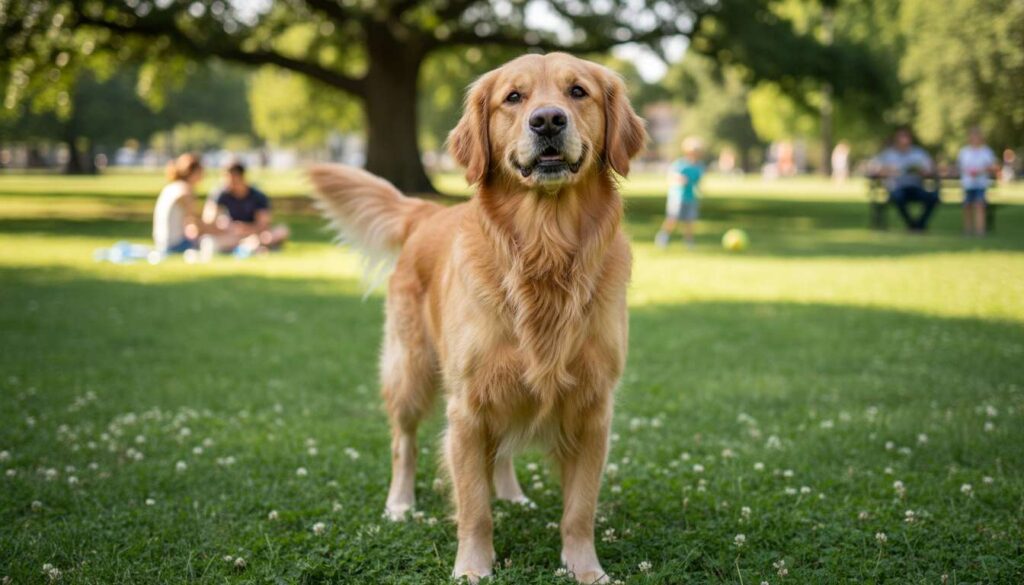
Canine body language provides the most immediate window into a dog’s emotional state. When expressing what appears to be gratitude, dogs typically exhibit:
- Relaxed posture with loose, flowing movements rather than rigid tension
- A gently wagging tail, often in broad sweeps rather than stiff, high positions
- Soft eyes with a relaxed gaze, sometimes described as “smiling eyes”
- Ears in a natural position, neither pinned back in fear nor forward in aggression
- An open mouth with tongue visible, resembling a contented expression
Vocal expressions
Whilst dogs cannot verbalise “thank you”, they produce distinctive vocalisations in response to positive interactions. These include soft whines of contentment, gentle huffing sounds, and what researchers term “play panting”—a rhythmic breathing pattern associated with positive emotional states. Some dogs develop unique vocal patterns specifically for their owners, suggesting intentional communication rather than reflexive responses.
Chemical communication
Recent research has identified oxytocin, often called the “bonding hormone”, as a key player in dog-human interactions. When dogs engage in positive exchanges with their owners, both species experience oxytocin increases, creating a mutual feedback loop of affection and trust. This biochemical response reinforces behaviours that maintain social bonds, essentially creating a physiological foundation for gratitude-like interactions.
These various signals combine to form recognisable patterns that dog owners encounter in everyday situations.
Behaviours that convey a “thank you”
Dogs demonstrate appreciation through specific, observable behaviours that occur consistently in response to human kindness or provision of resources. Recognising these patterns helps owners understand their pets’ emotional communications more accurately.
Physical contact and proximity
One of the most common ways dogs express gratitude involves seeking physical closeness with their benefactor. This manifests through:
- Leaning against the owner’s legs or body
- Gentle head-butting or nudging with the nose
- Placing a paw on the owner’s hand or lap
- Following the owner from room to room
- Settling nearby with body contact maintained
These proximity-seeking behaviours serve multiple functions, including reinforcing social bonds and expressing trust. When a dog chooses to remain close after receiving food, attention, or care, they’re demonstrating that the interaction held value beyond the immediate reward.
Gift-giving and sharing
Many dogs respond to kindness by bringing their owners toys, bones, or other prized possessions. This behaviour, whilst sometimes misinterpreted as a play invitation, often represents a reciprocal gesture. By offering something they value, dogs engage in a form of social exchange that mirrors human gift-giving traditions.
Grooming and licking
Licking serves multiple purposes in canine communication, but when directed at owners following positive interactions, it functions as an affiliative behaviour. Dogs lick pack members to reinforce social hierarchies and bonds, and when they lick human hands or faces after receiving care, they’re likely expressing appreciation through this instinctive social mechanism.
The play bow and invitation
Some dogs respond to positive experiences by initiating play, dropping into the characteristic play bow position with front legs extended and rear elevated. This invitation to engage in playful interaction represents a sharing of joy and a desire to prolong positive social engagement, functioning as a form of gratitude expression unique to canine communication.
Scientific investigation into these behaviours provides deeper insight into the mechanisms underlying dog-human relationships.
Researchers explain the human-dog bond
The relationship between humans and dogs represents one of the most extensively studied interspecies bonds in behavioural science. Contemporary research has illuminated the neurological, hormonal, and behavioural foundations that make this connection uniquely powerful.
The oxytocin feedback loop
Japanese researchers discovered that mutual gazing between dogs and owners triggers oxytocin release in both species, creating a self-reinforcing cycle of affection. This mechanism, previously thought to exist only between human mothers and infants, suggests that dogs have hijacked human bonding pathways through evolutionary adaptation.
| Interaction Type | Oxytocin Increase in Dogs | Oxytocin Increase in Humans |
|---|---|---|
| Extended eye contact | 130% | 300% |
| Physical petting | 57% | 42% |
| Verbal praise | 45% | 28% |
Attachment theory in dogs
Research applying attachment theory to dog-human relationships reveals that dogs form secure base attachments to their owners similar to those seen in human children. Dogs use their owners as sources of comfort during stress and display confidence when exploring unfamiliar environments with their trusted human present. This attachment framework provides context for understanding gratitude-like behaviours as expressions of secure emotional bonds.
Social cognition studies
Dogs demonstrate remarkable abilities to read human communicative signals, including pointing gestures, eye gaze direction, and emotional expressions. Studies show that dogs preferentially follow human cues over their own perceptions in certain contexts, suggesting they’ve evolved specialised social cognitive abilities for interacting with humans. This heightened sensitivity to human behaviour enables dogs to respond appropriately to kindness and generosity, forming the basis for gratitude-like responses.
However, interpreting these responses requires acknowledging the complexity and subtlety of canine communication systems.
The nuances of canine expression
Understanding whether dogs truly experience gratitude requires examining the contextual complexity of their emotional lives and the sophisticated ways they navigate social relationships.
Context-dependent responses
Dogs adjust their behaviour based on situational factors, demonstrating cognitive flexibility that suggests genuine emotional processing rather than simple stimulus-response patterns. A dog might respond differently to the same treat depending on whether they’ve been waiting patiently, whether other dogs are present, or whether the owner has been absent for an extended period. These nuanced responses indicate that dogs process social context when formulating their reactions.
Individual personality differences
Just as humans express gratitude differently based on personality, dogs show individual variation in how they demonstrate appreciation. Some dogs are effusive and physically demonstrative, whilst others express contentment through quiet proximity and calm demeanour. Recognising these personality-based differences prevents misinterpretation of a reserved dog’s gratitude as indifference or an enthusiastic dog’s excitement as mere food motivation.
Breed-specific tendencies
Selective breeding has created dogs with varying communicative styles and emotional expressiveness. Breeds developed for close human cooperation, such as retrievers and herding dogs, often display more obvious gratitude signals, whilst independent breeds may show appreciation more subtly. Understanding these breed-specific patterns helps owners recognise gratitude expressions that might otherwise go unnoticed.
Despite growing understanding of canine emotions, certain limitations constrain our ability to fully comprehend dogs’ inner experiences.
The limits of human interpretation
Whilst evidence strongly suggests dogs experience emotions analogous to gratitude, acknowledging the boundaries of our understanding remains crucial for accurate interpretation of canine behaviour.
The anthropomorphism challenge
Humans naturally project their own emotional experiences onto animals, a tendency called anthropomorphism. This can lead to both over-interpretation and under-interpretation of animal emotions. Whilst dismissing all dog behaviours as mere instinct ignores substantial evidence of emotional complexity, attributing fully human-like gratitude to dogs may overstate their cognitive capabilities. The truth likely lies in recognising that dogs experience gratitude-like states that serve similar social functions without necessarily involving the same conscious reflection humans engage in.
Communication barriers
The fundamental challenge in understanding canine gratitude stems from the impossibility of direct communication about internal states. Dogs cannot describe their feelings, and humans can only infer emotional experiences from observable behaviour and neurological activity. This creates an interpretive gap that science continues working to narrow but may never completely close.
The role of conditioning
Some behaviours interpreted as gratitude may result partially from operant conditioning, where dogs learn that certain responses to human generosity lead to additional positive outcomes. Distinguishing between learned responses and genuine emotional expressions presents ongoing challenges for researchers. However, the presence of conditioning doesn’t necessarily negate emotional experience—humans also learn socially appropriate ways to express gratitude whilst genuinely feeling thankful.
Future research directions
Advancing technology offers new possibilities for understanding canine emotions. Improved neuroimaging techniques, hormone analysis, and behavioural coding systems promise to reveal more about dogs’ internal experiences. Comparative studies across species may illuminate which aspects of gratitude-like behaviour are unique to dogs and which represent broader mammalian emotional capacities.
The question of whether dogs say “thank you” ultimately depends on how we define gratitude itself. If gratitude requires conscious reflection and verbal articulation, then dogs clearly cannot express it in human terms. However, if we understand gratitude as an emotional response to kindness that motivates reciprocal positive behaviour and strengthens social bonds, then dogs demonstrate this quality consistently and unmistakably. The behaviours dogs display—seeking proximity, offering valued possessions, engaging in affiliative gestures—serve the same social functions as human expressions of thanks. Recognising these communications enriches the human-dog relationship and deepens our appreciation for the emotional lives of our canine companions. As research continues to illuminate the neurological and behavioural foundations of dog emotions, the evidence increasingly supports what many owners have long believed: dogs possess their own authentic ways of expressing appreciation, gratitude, and love.