



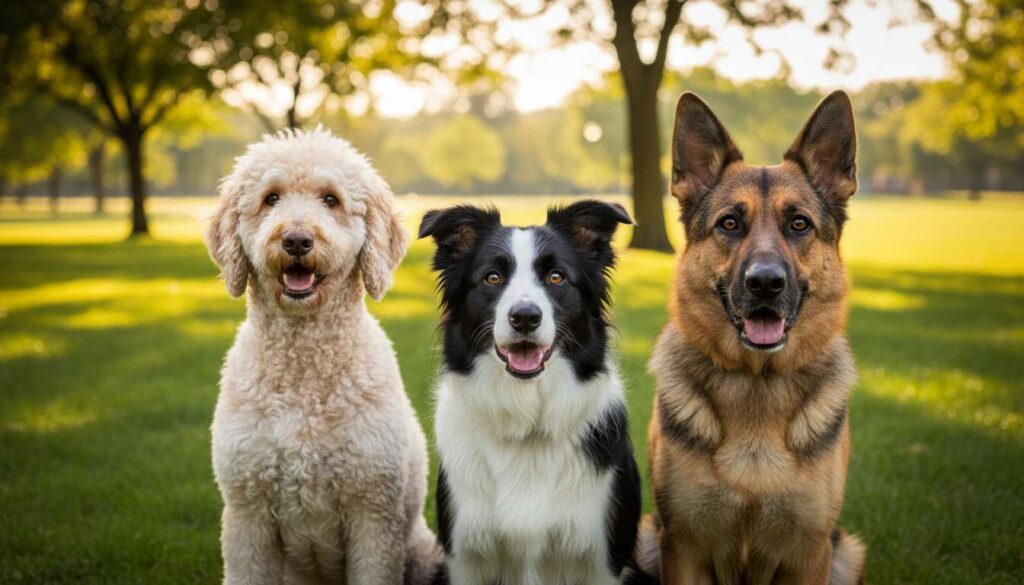
Dogs have captivated humans for millennia, not only through their loyalty and companionship but also through their remarkable cognitive abilities. Certain breeds stand out for their exceptional intelligence, demonstrating advanced problem-solving skills, rapid learning capabilities, and an impressive understanding of human communication. These highly intelligent breeds excel in various domains, from herding livestock to assisting law enforcement, and their mental prowess continues to fascinate researchers and dog enthusiasts alike. Identifying the most intelligent breeds requires examining specific criteria that measure canine cognitive performance and adaptability.
Understanding canine intelligence: criteria and characteristics
The three dimensions of dog intelligence
Canine intelligence manifests through three distinct types that researchers use to evaluate a dog’s cognitive abilities. Instinctive intelligence refers to the innate skills a breed was developed to perform, such as herding, retrieving, or guarding. Adaptive intelligence measures a dog’s ability to solve problems independently and learn from environmental experiences. Finally, working and obedience intelligence assesses how quickly a breed learns commands and how reliably they execute them.
Key indicators of superior canine cognition
Several observable characteristics distinguish highly intelligent dogs from their counterparts:
- Rapid command acquisition, often learning new instructions within five repetitions or fewer
- High success rate in obeying commands on the first attempt, typically exceeding 95 per cent
- Exceptional memory retention for commands and problem-solving strategies
- Advanced understanding of human gestures, facial expressions, and vocal tones
- Ability to generalise learned concepts to novel situations
These measurable traits provide a scientific foundation for ranking breeds according to their cognitive capabilities. Understanding these criteria helps explain why certain breeds consistently outperform others in training environments and working roles.
The role of breeding and purpose
Intelligence levels among dog breeds correlate strongly with their original purpose. Breeds developed for complex tasks requiring independent decision-making and close human cooperation tend to exhibit higher intelligence scores. Working dogs bred for herding, retrieval, or protection demonstrate superior cognitive abilities because their historical roles demanded quick thinking and adaptability. This relationship between function and intelligence provides insight into why specific breeds dominate intelligence rankings.
Having established the framework for assessing canine intelligence, examining the breeds that exemplify these qualities reveals fascinating examples of cognitive excellence.
The border collie, the prodigy of the canine world
Unmatched working intelligence
The border collie consistently ranks as the most intelligent dog breed across numerous studies and expert assessments. Originating from the border regions between England and Scotland, this breed was developed specifically for herding sheep in challenging terrain. Their extraordinary problem-solving abilities and intense focus enable them to make split-second decisions whilst managing livestock. Border collies can learn new commands in fewer than five repetitions and obey first commands with remarkable consistency.
Cognitive capabilities in action
Research has documented border collies performing cognitive feats that rival those of young children:
- Understanding over 1,000 words and object names
- Inferring the names of novel objects through process of elimination
- Anticipating human intentions based on subtle body language cues
- Solving complex spatial problems and navigating obstacle courses with minimal guidance
One famous border collie named Chaser demonstrated the ability to identify and retrieve 1,022 different toys by name, showcasing the breed’s exceptional memory and linguistic comprehension.
Energy and mental stimulation requirements
The border collie’s intelligence comes with significant responsibilities for owners. These dogs require extensive mental and physical stimulation to prevent boredom-related behavioural issues. Without adequate challenges, their cognitive abilities can manifest in destructive ways, including excessive barking, digging, or developing compulsive behaviours. Prospective owners must commit to providing daily training sessions, puzzle toys, and activities that engage the breed’s natural herding instincts.
Whilst the border collie excels in working intelligence, another breed combines cognitive prowess with remarkable versatility and elegance.
The poodle: a lively and cunning companion
Intelligence across all sizes
The poodle ranks consistently among the top three most intelligent breeds, with all three size variations – standard, miniature, and toy – demonstrating exceptional cognitive abilities. Originally bred in Germany as water retrievers, poodles possess a unique combination of athletic ability, trainability, and problem-solving skills. Their intelligence transcends size, making them versatile companions suitable for various living situations whilst maintaining their cognitive superiority.
Versatility and adaptability
Poodles excel in numerous roles that showcase their multifaceted intelligence:
| Role | Skills demonstrated |
|---|---|
| Service and therapy dogs | Emotional intelligence, task learning, public behaviour |
| Competitive obedience | Precision, memory, handler focus |
| Agility competitions | Spatial awareness, speed, problem-solving |
| Truffle hunting | Scent discrimination, persistence, communication |
Social intelligence and trainability
Beyond their working capabilities, poodles demonstrate remarkable social intelligence. They read human emotions with exceptional accuracy and adjust their behaviour accordingly. This breed learns complex trick sequences rapidly and retains training over extended periods. Poodles also exhibit creative problem-solving, often devising their own solutions to challenges rather than relying solely on learned responses. Their hypoallergenic coat and adaptable nature make them popular choices for families seeking an intelligent companion.
Another breed combines intelligence with protective instincts and unwavering dedication to duty.
The german shepherd: loyalty and versatility at the service of intelligence
A breed built for complex tasks
The german shepherd consistently ranks third in canine intelligence assessments, combining cognitive ability with physical prowess. Developed in Germany during the late 19th century, this breed was engineered to possess the ideal balance of intelligence, strength, and trainability for herding and protection work. Their capacity to learn complex task sequences and adapt to varied working environments has made them indispensable in military, police, and search-and-rescue operations worldwide.
Professional roles and capabilities
German shepherds demonstrate their intelligence through exceptional performance in demanding professional contexts:
- Detection work: identifying explosives, narcotics, and human remains with minimal false alerts
- Protection services: distinguishing genuine threats from benign situations
- Search and rescue: navigating disaster sites and locating survivors in challenging conditions
- Disability assistance: performing multi-step tasks to aid individuals with mobility or medical conditions
Temperament and training responsiveness
The german shepherd’s intelligence manifests through their remarkable trainability and focus. They form intense bonds with handlers and demonstrate unwavering dedication to assigned tasks. This breed learns new commands quickly, typically within five to fifteen repetitions, and maintains consistent performance under stressful conditions. Their balanced temperament allows them to remain calm during routine situations whilst responding decisively when circumstances demand action. German shepherds require confident, consistent training from experienced handlers who can channel their intelligence productively.
Understanding how experts measure and quantify these impressive cognitive abilities provides deeper insight into canine intelligence.
How is dog intelligence assessed ?
Stanley Coren’s influential research
Psychologist Stanley Coren’s groundbreaking work established the most widely recognised framework for ranking dog breeds by intelligence. His research, published in “The Intelligence of Dogs”, surveyed over 200 professional dog obedience judges to evaluate breeds based on working and obedience intelligence. The methodology assessed how many repetitions breeds required to learn new commands and their success rate in obeying known commands on the first attempt.
Scientific testing methods
Contemporary researchers employ various standardised tests to measure canine cognitive abilities:
| Test type | Measures |
|---|---|
| Object permanence | Understanding that hidden objects continue to exist |
| Detour navigation | Problem-solving around physical barriers |
| Social cognition | Following human pointing gestures and gaze direction |
| Memory tasks | Recalling hidden object locations after delays |
| Inferential reasoning | Deducing information through logical elimination |
Limitations and individual variation
Intelligence assessments provide valuable breed-level insights but cannot predict individual dog capabilities with absolute certainty. Factors including early socialisation, training quality, environmental enrichment, and genetic variation within breeds significantly influence cognitive development. Some dogs from less highly ranked breeds may outperform individuals from supposedly superior breeds. Additionally, different types of intelligence suit different purposes, meaning a breed’s ranking depends partly on which cognitive abilities researchers prioritise.
Armed with knowledge about canine intelligence and assessment methods, prospective owners can make informed decisions about breed selection.
Choosing the intelligent dog that suits you
Matching intelligence to lifestyle
Selecting a highly intelligent breed requires honest assessment of your lifestyle, experience level, and commitment capacity. Intelligent dogs demand substantial time investments in training, mental stimulation, and physical exercise. Prospective owners should consider:
- Available time for daily training sessions and interactive play
- Living space and access to areas for physical exercise
- Previous dog ownership and training experience
- Household composition, including children and other pets
- Financial resources for professional training if needed
The responsibility of owning intelligent breeds
Highly intelligent dogs can become challenging companions when their cognitive needs remain unmet. They may develop anxiety, destructive behaviours, or become overly demanding without proper mental engagement. Border collies, poodles, and german shepherds thrive with owners who view training as an ongoing relationship rather than a one-time achievement. These breeds require consistent mental challenges through puzzle toys, advanced obedience training, dog sports, or working activities that engage their natural abilities.
Alternatives and considerations
Intelligence represents only one factor in successful dog ownership. Some individuals may find greater satisfaction with breeds offering moderate intelligence combined with lower maintenance requirements. Temperament compatibility, grooming needs, health considerations, and energy levels deserve equal consideration. Consulting with breed-specific rescues, attending dog shows, and speaking with experienced owners provides valuable insights beyond intelligence rankings alone.
The border collie, poodle, and german shepherd represent the pinnacle of canine intelligence, each excelling through distinct cognitive strengths developed over generations of selective breeding. These breeds demonstrate that dog intelligence encompasses multiple dimensions, from rapid learning and obedience to problem-solving and social cognition. Whilst rankings provide useful guidance, successful ownership depends on matching a breed’s intelligence type and intensity to an owner’s lifestyle and capabilities. Prospective owners who appreciate the commitment required to nurture and channel exceptional canine intelligence will find these breeds to be rewarding, engaging companions capable of forming profound partnerships with their human families.