



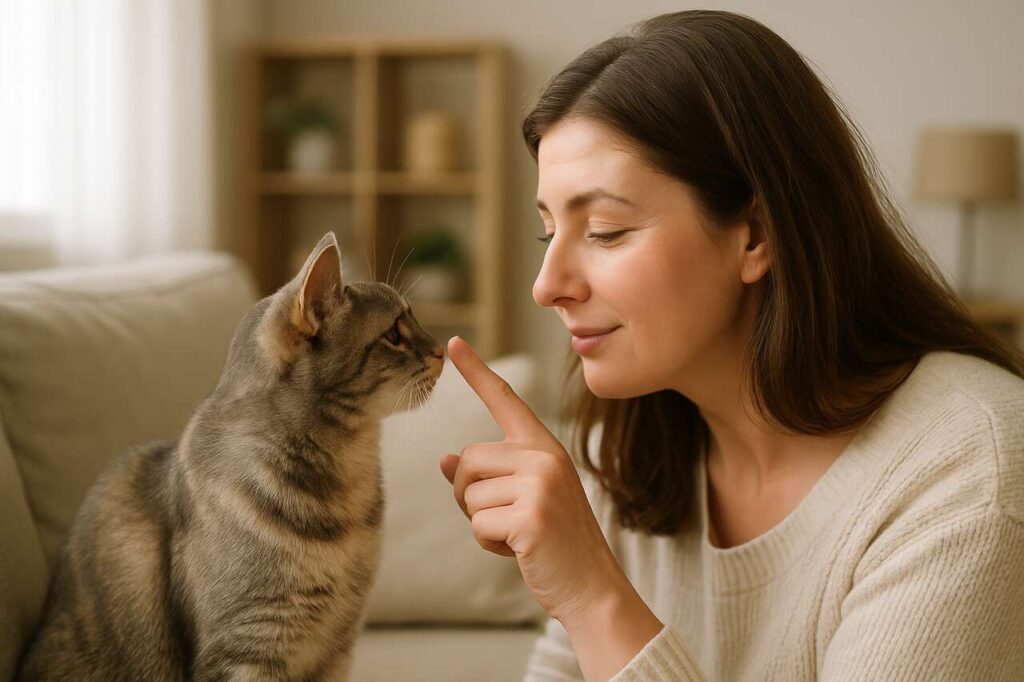
Cats have long been enigmatic companions, often leaving their owners puzzled by seemingly unpredictable behaviour. Recent research from animal behaviour scientists has uncovered a surprisingly straightforward method to enhance communication with felines: the slow blink. This simple gesture, which mimics the natural relaxation signals cats use amongst themselves, can transform the relationship between humans and their furry companions. Understanding how cats communicate through body language, vocalisations, and perception offers valuable insights into building stronger bonds with these independent creatures.
Understanding the body language of cats
Feline body language constitutes a sophisticated communication system that reveals emotional states and intentions. Cats rely heavily on physical cues to express themselves, making observation essential for successful interaction.
Tail positions and their meanings
The tail serves as a barometer of feline mood, with different positions conveying distinct messages. A vertically raised tail typically indicates contentment and friendliness, whilst a puffed-up tail signals fear or aggression. When the tail swishes rapidly from side to side, the cat experiences irritation or overstimulation, warning that interaction should cease. A gently curved tail resembling a question mark suggests playfulness and curiosity.
Ear movements as emotional indicators
Ear positioning provides crucial information about a cat’s emotional state:
- Forward-facing ears demonstrate alertness and interest
- Flattened ears against the head indicate fear or defensive aggression
- Rotating ears suggest the cat is monitoring multiple sounds in its environment
- Slightly backward ears may signal uncertainty or mild anxiety
Pupil dilation and eye contact
The eyes offer profound insights into feline psychology. Dilated pupils can indicate excitement, fear, or playfulness, depending on context. Conversely, narrowed pupils often accompany aggression or intense focus. Direct, prolonged eye contact represents a challenge or threat in cat language, whilst the slow blink—closing the eyes gradually and reopening them—communicates trust and affection.
These physical signals work in combination, creating a complex language that extends beyond simple gestures to encompass the entire feline form.
The importance of feline vocalisations
Whilst cats communicate primarily through body language with other felines, they have developed an extensive vocal repertoire specifically for human interaction.
Different types of meows and their purposes
Adult cats rarely meow at each other, reserving this vocalisation predominantly for humans. Research indicates that cats have refined their meows to manipulate human responses effectively. Short, high-pitched meows typically request attention or food, whilst longer, lower-pitched meows may express complaint or displeasure. The frequency and intensity of meowing often correlate with urgency.
Purring beyond contentment
Although commonly associated with happiness, purring serves multiple functions. Cats purr when content, but also when stressed, injured, or giving birth. Scientists believe purring may have self-healing properties, with vibrations at specific frequencies promoting bone density and tissue repair. Mother cats purr to guide blind, deaf kittens to nurse, demonstrating the sound’s communicative versatility.
Chirps, trills, and other sounds
Cats produce various other vocalisations that deserve attention:
- Chirping or chattering often occurs when watching prey through windows
- Trilling represents a friendly greeting, commonly used between cats and their trusted humans
- Hissing and growling clearly communicate fear or aggression
- Yowling may indicate distress, territorial disputes, or mating behaviour
Understanding these vocal nuances helps decode what cats attempt to communicate, bridging the interspecies communication gap.
How cats perceive humans
Cats view humans through a unique lens that differs significantly from how dogs perceive their owners, offering fascinating insights into feline psychology.
Cats as social opportunists
Research suggests cats regard humans as larger, non-hostile cats rather than as a different species entirely. They employ the same social behaviours with humans that they use with other felines, including rubbing, slow blinking, and bringing prey. This perception explains why cats often seem indifferent to human authority—they simply do not recognise hierarchical relationships as dogs do.
Scent recognition and bonding
Cats possess approximately 200 million scent receptors, making smell their primary identification method. When cats rub against humans, they deposit pheromones from facial glands, marking their owners as familiar and safe. This scent-marking behaviour creates a shared colony scent that reinforces social bonds.
Visual perception differences
| Aspect | Human vision | Feline vision |
|---|---|---|
| Colour perception | Full spectrum | Limited blues and greens |
| Night vision | Poor | Excellent (6-8 times better) |
| Motion detection | Moderate | Highly sensitive |
| Close-up focus | Sharp | Blurry (objects closer than 30cm) |
These perceptual differences influence how cats interpret human gestures and movements, making some actions more effective than others.
The gestures to adopt to communicate with your cat
Implementing specific techniques can dramatically improve human-feline communication, with the slow blink technique proving particularly effective.
Mastering the slow blink
Scientists have confirmed that the slow blink functions as a feline smile. To execute this properly, make eye contact with your cat, then slowly close your eyes for two to three seconds before reopening them. Cats frequently reciprocate, establishing a positive feedback loop. This gesture signals non-threatening intentions and builds trust, particularly useful with anxious or unfamiliar cats.
Appropriate petting techniques
Most cats prefer being stroked on areas with scent glands:
- The cheeks and chin, where facial glands are concentrated
- Behind the ears, a generally pleasurable spot
- The base of the tail, though some cats find this overstimulating
- Gentle head scratches between the ears
Avoid touching the belly unless explicitly invited, as this vulnerable area triggers defensive responses in many cats.
Respecting personal space
Allowing cats to initiate contact demonstrates respect for their autonomy. Rather than approaching directly, sit nearby and let the cat come to you. Extending a finger at cat nose-height mimics the feline greeting of nose-touching, providing a non-threatening introduction method.
These conscious adjustments to human behaviour align with feline communication preferences, creating more harmonious interactions.
The mistakes to avoid to prevent mixed messages
Well-intentioned actions can inadvertently create confusion or stress for cats, undermining communication efforts.
Forced physical interaction
Restraining cats against their will or persisting with unwanted attention damages trust. When a cat displays avoidance behaviours—flattened ears, tail swishing, or attempting to leave—continuing interaction communicates disrespect for their boundaries. This can lead to defensive aggression or fearful withdrawal.
Inconsistent responses
Cats thrive on predictability. Responding differently to the same behaviour confuses them and hinders learning. For example, sometimes allowing a cat on the kitchen counter whilst other times shooing them away creates unclear expectations. Consistency in reactions helps cats understand household rules.
Misinterpreting play aggression
Common errors include:
- Using hands as toys, which teaches cats that biting fingers is acceptable
- Encouraging rough play that escalates into genuine aggression
- Failing to recognise overstimulation signals during petting
- Punishing natural hunting behaviours rather than redirecting them appropriately
Neglecting environmental communication
Cats communicate through territorial marking and spatial arrangements. Frequently rearranging furniture, moving litter boxes, or eliminating scratching posts disrupts their environmental language, causing stress and potential behavioural issues.
Avoiding these pitfalls creates clearer communication channels and strengthens the human-cat relationship.
The benefits of good communication with your feline
Effective communication yields numerous advantages for both cats and their human companions, extending beyond simple convenience.
Reduced stress and anxiety
When cats feel understood, their cortisol levels decrease, promoting better overall health. Clear communication reduces uncertainty about human intentions, creating a more relaxed household environment. This particularly benefits rescue cats or those with traumatic histories, helping them develop security and confidence.
Improved veterinary care
Cats who trust their owners through established communication patterns cope better with medical handling. Understanding stress signals allows owners to advocate effectively during veterinary visits, whilst cats accustomed to positive human interaction often tolerate examinations more cooperatively.
Enhanced mutual enjoyment
Strong communication deepens the human-animal bond, creating more rewarding companionship. Cats who feel secure express their personalities more fully, displaying playfulness, affection, and individual quirks. Owners gain satisfaction from successfully interpreting and responding to their cat’s needs.
Behavioural problem prevention
Many feline behavioural issues stem from communication breakdowns. Addressing needs before frustration escalates prevents:
- Inappropriate elimination outside litter boxes
- Destructive scratching of furniture
- Excessive vocalisation or attention-seeking
- Aggression towards household members or other pets
Recognising early warning signs allows proactive intervention, maintaining household harmony.
The science of feline communication reveals that cats possess sophisticated social abilities often underestimated by humans. Simple techniques like the slow blink, combined with understanding body language and respecting feline perception, create meaningful connections with these enigmatic companions. Avoiding common mistakes whilst implementing appropriate gestures transforms daily interactions, reducing stress and enhancing mutual enjoyment. As research continues to unveil the complexities of cat behaviour, the tools for successful communication become increasingly accessible, enabling owners to build deeper, more rewarding relationships with their feline friends.