



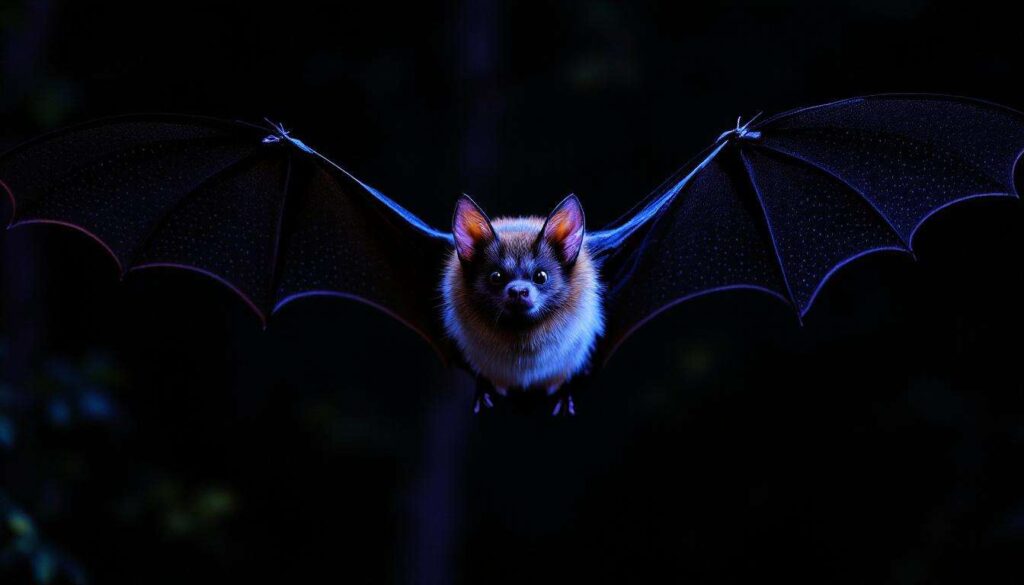
When researchers first illuminated bats with ultraviolet light in darkened laboratories, they witnessed an unexpected spectacle: the nocturnal mammals began to glow with vibrant hues of pink, green, and orange. This remarkable discovery has opened new avenues in understanding how these flying creatures navigate their world and interact with their environment. The phenomenon of bat fluorescence challenges previous assumptions about mammalian vision and sensory perception, revealing that nature still holds countless surprises even in well-studied species.
Understanding the phenomenon of bat fluorescence
The science behind glowing fur
Bat fluorescence occurs when ultraviolet light strikes specific compounds within the animals’ fur and skin, causing them to emit visible light at longer wavelengths. This process differs fundamentally from bioluminescence, as it requires an external light source rather than internal chemical reactions. Research has identified that porphyrins, naturally occurring compounds in mammalian tissue, are primarily responsible for this glowing effect in bats.
The intensity and colour of fluorescence vary significantly across different bat species:
- Flying foxes exhibit bright green fluorescence on their wing membranes
- Weasel bats display vivid pink colouration under UV exposure
- Springhare species show orange-red fluorescence patterns
- Some insectivorous bats reveal subtle blue-white glows
Distribution across bat populations
Scientists have documented fluorescence in multiple bat families worldwide, suggesting this trait is more widespread than initially anticipated. Studies examining museum specimens and live populations have revealed that the phenomenon transcends geographical boundaries and taxonomic classifications. The universal presence of porphyrins in mammalian biology indicates that fluorescence capability may be an inherent characteristic rather than a specialised adaptation.
| Bat Family | Fluorescence Colour | Primary Location |
|---|---|---|
| Pteropodidae | Green | Wing membranes |
| Vespertilionidae | Pink-red | Fur and ears |
| Molossidae | Orange | Facial features |
This widespread occurrence raises intriguing questions about whether bats can actually perceive their own fluorescence and utilise it for communication or navigation purposes.
Scientific discoveries on bioluminescence
Distinguishing fluorescence from bioluminescence
Whilst the glowing appearance of bats under UV light is striking, it is crucial to clarify that this phenomenon represents fluorescence rather than true bioluminescence. Bioluminescence involves organisms producing light through internal chemical reactions, as seen in fireflies and certain deep-sea creatures. In contrast, fluorescence requires external UV light to trigger the emission of visible light, making it a passive rather than active process.
Research methodologies and breakthroughs
Contemporary research into bat fluorescence employs sophisticated techniques:
- Spectrophotometry to analyse wavelength absorption and emission patterns
- High-resolution photography capturing fluorescence in natural habitats
- Biochemical analysis identifying specific fluorescent compounds
- Comparative studies across mammalian species
These investigations have revealed that porphyrin concentrations vary seasonally in some bat species, potentially correlating with reproductive cycles or dietary changes. Furthermore, researchers have discovered that the intensity of fluorescence can indicate the health status of individual bats, with compromised immune systems sometimes affecting porphyrin production.
Such findings have prompted scientists to explore whether similar fluorescent properties exist in other nocturnal mammals and what ecological roles they might serve.
Impact of ultraviolet light on bats
Natural UV exposure in bat habitats
Bats encounter ultraviolet light regularly in their natural environments, particularly during twilight hours when they emerge from roosts. Whilst humans cannot perceive UV wavelengths without specialised equipment, many animals possess visual systems adapted to detect these frequencies. The question of whether bats themselves can see UV light remains partially answered, with evidence suggesting that some species possess limited UV sensitivity.
Behavioural responses to UV illumination
Laboratory observations have documented various bat responses when exposed to ultraviolet light:
- No apparent distress or avoidance behaviours in most species
- Continued normal social interactions during UV exposure
- Unchanged echolocation patterns under UV illumination
- Some species showing increased grooming activity
These observations suggest that artificial UV exposure does not significantly disturb bat behaviour, though long-term effects require further investigation. Researchers must balance the scientific value of UV studies with ethical considerations regarding animal welfare and natural behaviour patterns.
Understanding how bats interact with UV light in their ecosystems provides context for exploring potential evolutionary benefits of fluorescence.
Evolutionary advantages of fluorescence in mammals
Communication and species recognition
One compelling hypothesis suggests that fluorescence serves as a visual communication mechanism among bats. If these animals can perceive UV light and the resulting fluorescence, the glowing patterns could facilitate:
- Species identification in mixed roosting colonies
- Mate selection based on fluorescence intensity or pattern
- Individual recognition within social groups
- Territorial displays or dominance signalling
Camouflage and predator avoidance
Paradoxically, fluorescence might also provide camouflage advantages in specific environmental contexts. Under moonlight conditions, which contain UV wavelengths, fluorescent fur could help bats blend with UV-reflective vegetation or break up their silhouette against the night sky. This counter-intuitive defensive strategy would be particularly effective against predators lacking UV vision.
| Potential Advantage | Supporting Evidence | Research Status |
|---|---|---|
| Mate attraction | Seasonal variation in intensity | Under investigation |
| Species recognition | Distinct patterns per species | Preliminary data |
| Camouflage | Environmental UV reflectance | Theoretical |
These evolutionary perspectives connect directly to broader conservation concerns as human activities increasingly alter the environments where these adaptations evolved.
Implications for bat conservation
Monitoring population health through fluorescence
The discovery of bat fluorescence offers novel conservation tools for researchers and wildlife managers. Non-invasive UV photography can potentially assess population health without capturing or handling individual animals. Changes in fluorescence patterns might indicate:
- Nutritional deficiencies affecting porphyrin production
- Disease prevalence within colonies
- Environmental contamination impacting metabolic processes
- Stress responses to habitat disturbance
Light pollution considerations
As artificial lighting increasingly pervades natural habitats, understanding how UV components of light pollution affect bats becomes critical. If fluorescence plays functional roles in bat ecology, anthropogenic UV sources could disrupt natural behaviours. Conservation strategies must therefore consider:
- Spectral composition of outdoor lighting near bat habitats
- Timing of artificial illumination relative to bat activity periods
- Shielding requirements to minimise UV scatter
- Protected dark corridors for bat foraging and migration
These insights emphasise that effective bat conservation requires comprehensive understanding of sensory ecology, including visual phenomena that remain invisible to human observers without technological assistance.
The revelation that bats glow under ultraviolet light represents far more than a curious biological oddity. This phenomenon illuminates the complexity of mammalian sensory systems and challenges researchers to reconsider how nocturnal animals perceive and navigate their environments. From potential communication functions to conservation applications, bat fluorescence opens new research directions that may ultimately enhance protection efforts for these ecologically vital creatures. As scientists continue investigating the mechanisms and purposes of this glowing trait, they remind us that even familiar animals harbour mysteries waiting to be discovered through innovative observation techniques.