



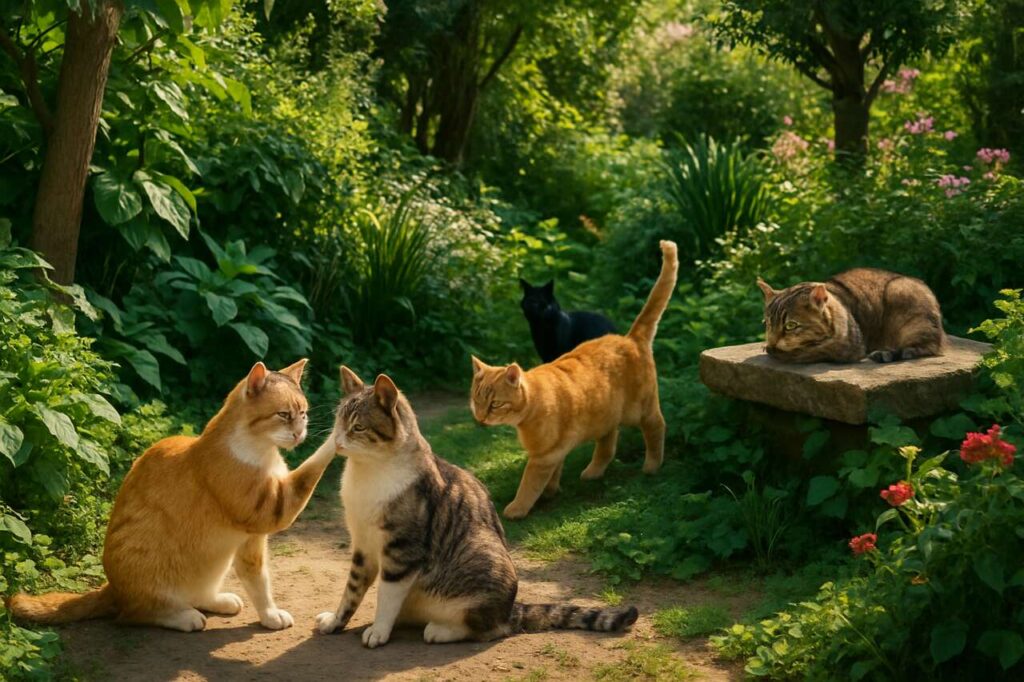
Beneath the flowerbeds and garden sheds, an invisible social network thrives. Free-ranging domestic cats have established intricate colonies across residential areas, forming relationships and hierarchies that scientists are only beginning to understand. These feline communities, often hidden from human view, operate according to complex rules of interaction, territory, and resource sharing. Recent research has revealed that the cats wandering through our gardens are not solitary wanderers but participants in a sophisticated social structure that rivals many wild animal populations.
The mysteries of cat colonies in our gardens
The structure of feline social networks
Cat colonies represent a fascinating departure from the traditional view of cats as solitary hunters. These groups typically form around reliable food sources, whether provided intentionally by humans or discovered opportunistically. Within these colonies, cats establish hierarchical relationships based on factors including age, sex, and length of residency in the territory.
The social dynamics within cat colonies include:
- Core members who maintain stable territories and relationships
- Peripheral individuals who interact less frequently with the group
- Transient cats who pass through without establishing permanent bonds
- Matriarchal structures where related females often form the colony nucleus
The concept of the catscape
Researchers have introduced the term catscape to describe the complex spatial and social landscape created by free-ranging cats. This concept encompasses not only the physical territories cats occupy but also the invisible boundaries and pathways they establish through repeated use. The catscape overlaps with human residential areas, creating a parallel world that most homeowners never fully observe.
| Territory type | Average size | Primary use |
|---|---|---|
| Core territory | 0.5-2 hectares | Resting and feeding |
| Home range | 2-10 hectares | Hunting and socialising |
| Shared spaces | Variable | Neutral meeting zones |
Understanding these territorial patterns has become crucial for comprehending how cats interact with both their environment and each other, setting the stage for more detailed scientific investigation.
The study of social behaviour in feral cats
Observational research techniques
Scientists studying cat colonies employ various observational methods to document feline behaviour. Traditional approaches include direct observation during dawn and dusk hours when cats are most active. Researchers record interactions between individuals, noting affiliative behaviours such as grooming, nose-touching, and resting in proximity, as well as agonistic encounters involving hissing, swatting, or chasing.
Social bonds and relationships
Contrary to popular belief, cats within colonies form genuine social bonds that extend beyond mere tolerance. Female cats, particularly those related by blood, often demonstrate cooperative behaviours including:
- Communal nursing of kittens
- Shared vigilance against predators or threats
- Coordinated use of preferred resting areas
- Mutual grooming that reinforces social connections
Male cats typically maintain looser associations, with their social interactions often dictated by reproductive opportunities and territorial considerations. Neutered males, however, frequently integrate more peacefully into colony structures, displaying reduced aggression and greater acceptance of proximity to other cats.
Communication within colonies
Feline communication relies on a sophisticated combination of vocal, visual, and olfactory signals. Cats utilise scent marking through facial rubbing, scratching, and urine spraying to establish territorial boundaries and convey information about their reproductive status. Body language, including tail position, ear orientation, and pupil dilation, provides real-time communication during face-to-face encounters.
These communication systems enable cats to maintain their complex social networks whilst minimising direct conflict, but the tools scientists use to document these behaviours have evolved considerably.
Scientific methods for mapping feline colonies
GPS tracking technology
Modern research has revolutionised the study of cat colonies through GPS tracking devices. These lightweight collars record feline movements with remarkable precision, revealing patterns invisible to human observers. Scientists can now map the exact routes cats take through gardens, identify frequently visited locations, and determine how individual territories overlap.
| Technology | Data collected | Research application |
|---|---|---|
| GPS collars | Location coordinates | Territory mapping |
| Camera traps | Visual identification | Population counts |
| Microchip scanners | Individual identity | Movement tracking |
Network analysis approaches
Researchers apply social network analysis, a methodology borrowed from sociology, to understand relationships within cat colonies. This approach treats individual cats as nodes and their interactions as connections, creating visual maps of social structure. These networks reveal which cats occupy central positions within colonies and which remain on the periphery.
Citizen science contributions
The involvement of citizen scientists has expanded research capabilities considerably. Cat owners who allow their pets outdoor access provide valuable data by reporting sightings, photographing visiting cats, and noting interaction patterns. This crowdsourced information helps researchers understand colony dynamics across broader geographical areas than professional teams could cover alone.
Whilst these mapping techniques reveal the hidden social world of cats, they also expose the broader environmental consequences of feline populations.
The impact of cat colonies on local biodiversity
Predation on wildlife
Free-ranging cats function as generalist predators with substantial impacts on local fauna. Research indicates that cats consume over two thousand different species globally, including birds, small mammals, reptiles, and amphibians. Their predatory behaviour affects wildlife populations through both direct mortality and indirect stress effects that alter prey behaviour and reproductive success.
Species particularly vulnerable to cat predation include:
- Ground-nesting birds during breeding season
- Small rodents and shrews
- Juvenile rabbits and hares
- Lizards and slow-moving reptiles
- Amphibians near garden ponds
Conservation concerns
The ecological impact becomes especially pronounced when cats prey upon species of conservation concern. Studies have identified 347 threatened or endangered species affected by cat predation, with impacts most severe in island ecosystems where native wildlife evolved without mammalian predators. Even in mainland settings, cats can significantly reduce populations of already vulnerable species.
| Ecosystem type | Risk level | Affected species |
|---|---|---|
| Island habitats | Very high | Native birds, reptiles |
| Urban gardens | Moderate | Songbirds, small mammals |
| Rural areas | High | Ground-nesting birds |
Ecosystem disruption
Beyond direct predation, cat colonies contribute to ecosystem disruption through competition with native predators and disease transmission. Cats compete with species such as foxes and birds of prey for similar food resources, potentially displacing these natural predators from their ecological niches. Additionally, feline diseases can spread to wild cat species and other carnivores.
These environmental challenges have prompted urgent discussions about how human communities should respond to feral cat populations.
Implications for managing feral cat populations
The trap-neuter-return debate
The trap-neuter-return approach represents one of the most contentious strategies for managing feral cats. Advocates argue that TNR programmes humanely reduce cat populations over time whilst avoiding euthanasia. Critics contend that these programmes perpetuate ecological damage by maintaining cats in environments where they continue predating wildlife, albeit without reproducing.
Alternative management strategies
Various alternative approaches have been proposed or implemented with differing degrees of success:
- Contained cat policies requiring cats to remain on owner property
- Designated cat-free zones in areas with sensitive wildlife
- Removal and rehoming programmes for adoptable feral cats
- Public education campaigns about responsible cat ownership
- Breeding restrictions and mandatory desexing requirements
Balancing welfare and conservation
Effective cat management requires balancing animal welfare concerns with conservation priorities. Solutions must acknowledge that cats themselves are not responsible for their ecological impacts; rather, human decisions about pet ownership and feeding practices create the conditions enabling feral colonies to thrive. Ethical frameworks for addressing this challenge must consider the wellbeing of cats, the protection of native wildlife, and the values of human communities.
Finding this balance necessitates collaboration between diverse stakeholders to develop practical solutions for shared spaces.
Towards a better coexistence between humans and felines
Responsible cat ownership practices
Individual cat owners can significantly reduce ecological impacts through responsible ownership practices. Keeping cats indoors, particularly during dawn and dusk when wildlife is most active, substantially decreases predation. For cats requiring outdoor access, enclosed outdoor spaces or supervised garden time on harnesses provides environmental enrichment whilst protecting wildlife.
Community-level interventions
Effective coexistence requires coordinated community action including:
- Establishing feeding stations to concentrate cat activity away from wildlife habitats
- Creating wildlife-friendly gardens with protective vegetation
- Implementing local cat registration and identification systems
- Supporting subsidised desexing programmes
- Developing neighbourhood agreements about cat management
Future research directions
Ongoing research continues to refine understanding of cat colony dynamics and their environmental impacts. Emerging technologies, including analysis of social media data documenting pet behaviours, may provide unprecedented insights into feline populations. Scientists are also investigating how environmental modifications might reduce hunting success without compromising cat welfare, such as collar-mounted devices that warn prey of approaching predators.
The hidden social networks mapped by researchers reveal both the complexity of feline societies and the challenges they pose for biodiversity conservation. Addressing these challenges requires acknowledging the legitimate interests of cats, wildlife, and human communities whilst working towards solutions that respect all stakeholders. As scientific understanding deepens, opportunities emerge for more nuanced approaches that move beyond polarised debates towards practical coexistence strategies. The cats in our gardens will continue forming their invisible networks, but human choices will ultimately determine whether these networks can coexist sustainably with the broader web of life.