



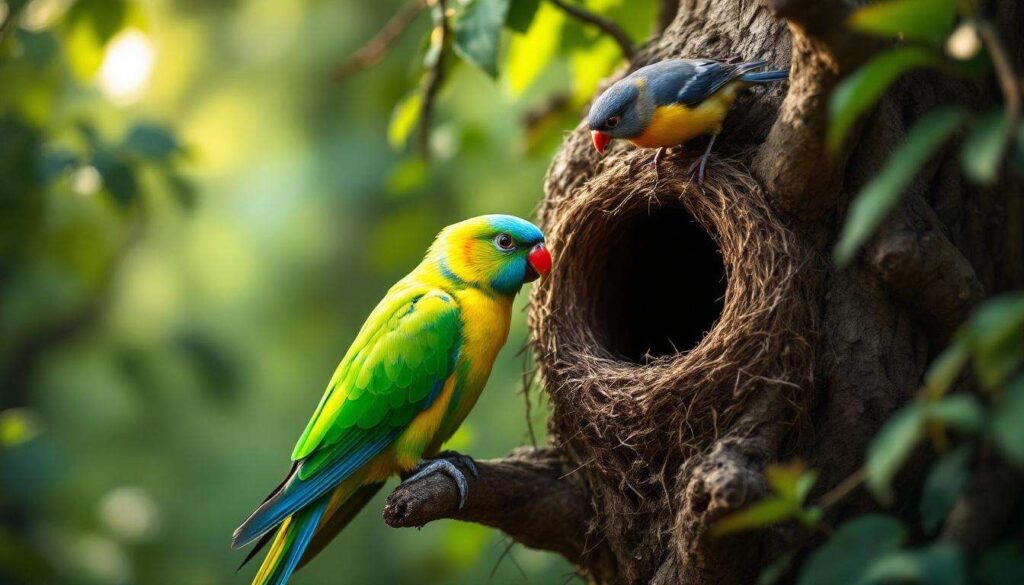
Bright green flashes darting through London’s parks and gardens have become an increasingly common sight. Ring-necked parakeets, with their vivid plumage and raucous calls, now populate urban and suburban areas across Great Britain. Yet beneath the spectacle of these exotic arrivals lies a pressing ecological question: are these colourful immigrants displacing native bird species from their traditional nesting sites ? Data collected by the British Trust for Ornithology offers crucial insights into this contentious issue, revealing patterns that challenge simple assumptions about invasive species and their impacts on local wildlife.
Introduction to ring-necked parakeets
Physical characteristics and behaviour
Ring-necked parakeets are unmistakable birds measuring approximately 40 centimetres in length, with their distinctive emerald-green plumage and long, pointed tail feathers. Adult males display a characteristic pink and black collar around their necks, whilst females and juveniles lack this distinctive marking. Their powerful, curved beaks are perfectly adapted for cracking nuts and seeds, making them highly efficient foragers in both natural and urban environments.
These gregarious birds are known for their noisy social behaviour, often gathering in large flocks at communal roosts. Their loud, screeching calls can be heard from considerable distances, particularly during dawn and dusk when they travel between feeding and roosting sites. Unlike many native British species, ring-necked parakeets demonstrate remarkable adaptability to human presence, readily exploiting garden feeders and ornamental trees in residential areas.
Natural habitat requirements
In their native range across Africa and Asia, ring-necked parakeets inhabit woodland edges, cultivated areas, and parkland. They are cavity nesters, requiring holes in mature trees for breeding and roosting. This particular nesting requirement places them in direct competition with native species that share similar habitat needs. The birds typically seek out cavities large enough to accommodate their size, often favouring sites in deciduous trees such as oak, beech, and plane trees commonly found in British parks and gardens.
Understanding these habitat preferences provides essential context for assessing how parakeets might interact with native wildlife in their adopted British home.
Origin and spread of parakeets in Great Britain
Establishment of feral populations
The origins of Britain’s parakeet populations remain somewhat mysterious, with various theories circulating about their initial introduction. Most ornithologists agree that the current populations descend from escaped or deliberately released cage birds, with establishment occurring over several decades. The species’ ability to survive British winters initially surprised many experts, but their adaptability has proven remarkably successful.
The first documented sighting within the British Trust for Ornithology’s Garden BirdWatch programme occurred in March 2022, marking a significant milestone in monitoring efforts. Observations remained sporadic until November 2022, when sightings intensified dramatically, with groups of up to 15 individuals recorded at single locations. This pattern suggests an accelerating expansion phase in certain regions.
Population growth and distribution
The demographic trajectory of ring-necked parakeets in Britain has been nothing short of remarkable. Studies conducted by members of the ornithological community reveal a substantial population increase, with numbers rising from approximately 1,200 individuals in 2016 to around 6,300 in 2022. This represents more than a fivefold increase within just six years, indicating highly successful breeding and survival rates.
| Year | Estimated Population |
|---|---|
| 2016 | 1,200 |
| 2022 | 6,300 |
Distribution patterns show concentrations in the south-east of England, particularly around Greater London, though sightings are increasingly reported in other regions. This geographical expansion raises important questions about the species’ potential ecological footprint across Britain’s diverse habitats.
Ecological impact of parakeets on native birds
Competition for nesting cavities
The most significant concern regarding parakeets centres on competition for nesting sites. Tree cavities suitable for nesting are a limited resource, particularly in urban and suburban environments where mature trees are scarce. Native species that rely on these cavities include nuthatches, starlings, stock doves, and several woodpecker species. When parakeets occupy these sites, they may prevent native birds from accessing crucial breeding habitat.
Research conducted in other countries has demonstrated that parakeets, as invasive species, can lead to declines in certain bird populations due to this competition. A study published in May 2018 reported that invasive parakeets had negative effects on species such as the greater noctule, a type of bat, due to their competition for tree cavities. This international evidence suggests potential mechanisms through which parakeets might impact British wildlife, though direct evidence from Britain remains limited.
Population trends in native species
British Trust for Ornithology data reveals a complex picture regarding native bird populations. Some species have experienced declines during the period of parakeet expansion, whilst others have increased. Species showing declines include:
- Sparrows
- Magpies
- Dunnocks
Conversely, populations of the following species have actually increased:
- Pigeons
- Woodpeckers
- Jays
However, establishing direct causation between parakeet presence and these population changes remains challenging. Multiple factors influence bird populations, including habitat loss, climate change, predation, and disease. The correlation between parakeet expansion and native bird declines does not necessarily prove causation, and ornithologists emphasise the need for caution when interpreting these patterns.
These nuanced findings from British data contrast with simpler narratives about invasive species impacts, highlighting the importance of robust monitoring programmes.
BTO data revealing invasion trends
Garden BirdWatch programme methodology
The British Trust for Ornithology’s Garden BirdWatch programme represents one of the most comprehensive citizen science initiatives in ornithology. Thousands of participants across Britain record bird sightings in their gardens weekly, providing a vast dataset that tracks population trends and distribution patterns over time. This long-term monitoring enables researchers to identify emerging patterns, such as the establishment and spread of non-native species like ring-necked parakeets.
The programme’s strength lies in its geographical coverage and temporal consistency, offering insights that would be impossible to obtain through traditional scientific surveys alone. Data quality is maintained through standardised recording protocols and validation procedures, ensuring reliability for scientific analysis.
Key findings from recent observations
Recent observations from the Garden BirdWatch programme indicate that parakeet presence in British gardens is becoming increasingly frequent. The intensification of sightings from November 2022 onwards suggests either population growth, range expansion, or increased willingness of parakeets to exploit garden resources. The recording of groups containing up to 15 individuals demonstrates that parakeets are not merely occasional visitors but are establishing regular feeding patterns in residential areas.
These data points provide essential baseline information for assessing future trends and potential impacts on garden biodiversity.
Perceptions of British residents towards parakeets
Public attitudes and responses
British residents display mixed reactions to the presence of ring-necked parakeets in their neighbourhoods. Many people appreciate the exotic colour and vitality these birds bring to urban environments, viewing them as a positive addition to local wildlife. Garden bird enthusiasts often express delight at observing these charismatic birds at feeders, and their presence has undoubtedly increased public engagement with urban nature.
However, concerns also exist. Some residents find the parakeets’ loud vocalisations disruptive, particularly when large flocks gather near residential properties. Others worry about the birds’ potential impact on native species, reflecting broader anxieties about invasive species and ecological change. The debate around parakeets thus reflects wider tensions between aesthetic appreciation and ecological responsibility.
Understanding these diverse perspectives is crucial for developing effective management strategies that balance ecological concerns with public sentiment.
Solutions for coexisting with this invasive species
Monitoring and research priorities
Given the insufficient scientific evidence currently available regarding parakeets’ impact on native British birds, ongoing monitoring remains essential. Ornithologists emphasise the need for continued data collection through programmes like Garden BirdWatch, alongside targeted research into nesting site competition and resource use. Long-term studies tracking both parakeet populations and native species in the same locations would provide valuable insights into competitive interactions.
Research priorities should include:
- Detailed studies of cavity nesting competition in areas with high parakeet densities
- Assessment of dietary overlap between parakeets and native species
- Monitoring of breeding success rates in native birds where parakeets are present
- Evaluation of potential disease transmission risks
Practical management approaches
Management strategies for parakeet populations must balance ecological concerns with practical and ethical considerations. Complete eradication appears neither feasible nor necessarily desirable given current population sizes and public attitudes. Instead, targeted interventions might focus on protecting particularly vulnerable native species or sensitive habitats. Providing additional nesting boxes designed for specific native species could help mitigate competition for natural cavities, though this approach requires careful implementation to avoid inadvertently benefiting parakeets.
Public education about responsible bird feeding practices and the importance of preserving mature trees with natural cavities can support broader conservation goals whilst acknowledging the established presence of parakeets in the British avifauna.
While ring-necked parakeets undoubtedly represent a significant change to Britain’s bird communities, the evidence regarding their impact on native species remains complex and incomplete. British Trust for Ornithology data reveals population increases in parakeets alongside mixed trends in native birds, but establishing direct causal relationships requires further research. Recent observations suggest that coexistence may be possible in many contexts, though concerns about competition for nesting cavities warrant continued attention. As parakeet populations continue to grow and expand geographically, ongoing monitoring through citizen science programmes will prove invaluable for understanding long-term ecological consequences. The challenge facing ornithologists and conservationists lies in gathering robust evidence to inform management decisions whilst recognising that these colourful immigrants have become an established part of Britain’s urban wildlife landscape.