



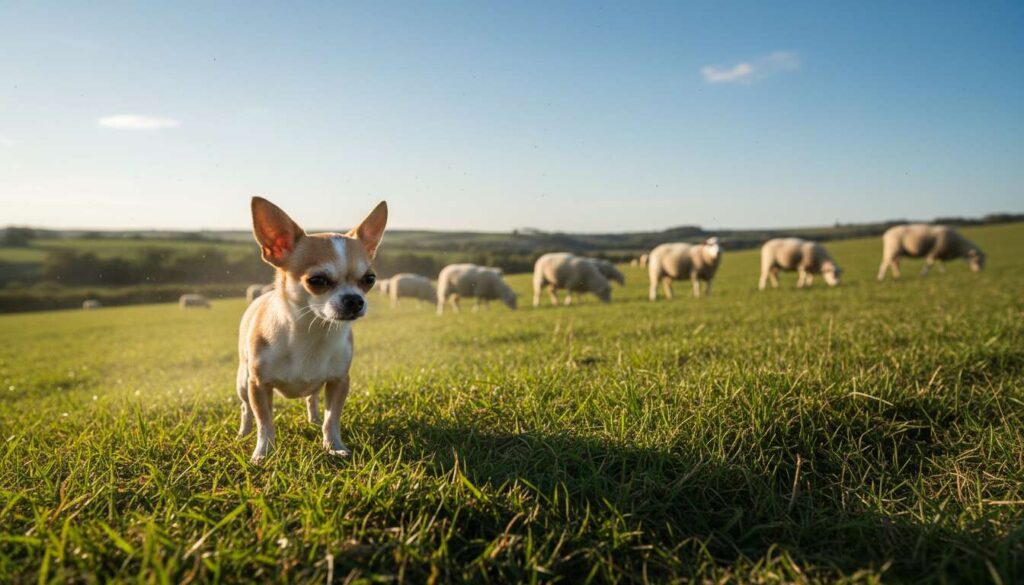
The question of whether a diminutive Chihuahua could fulfil the demanding role of a herding dog sparks both curiosity and scepticism. Whilst traditional herding breeds like Border Collies and Australian Shepherds dominate pastoral landscapes, the notion of a tiny companion breed managing livestock seems improbable at first glance. Yet examining this possibility reveals fascinating insights into canine behaviour, breed characteristics, and the specific requirements of herding work. This exploration delves into the biological, behavioural, and practical considerations surrounding this unconventional proposition.
The characteristics of the Chihuahua: a detailed analysis
Physical attributes and limitations
The Chihuahua stands as the smallest recognised dog breed, typically weighing between 1.8 and 2.7 kilograms and measuring 15 to 23 centimetres in height. These diminutive dimensions present immediate challenges for any physically demanding task. Their skeletal structure, whilst proportionate, lacks the robustness required for extended physical exertion across varied terrain.
| Physical characteristic | Chihuahua measurement | Typical herding breed measurement |
|---|---|---|
| Weight | 1.8-2.7 kg | 14-25 kg |
| Height | 15-23 cm | 46-58 cm |
| Endurance level | Low to moderate | High to very high |
Temperament and personality traits
Chihuahuas possess a surprisingly bold temperament despite their size. These dogs demonstrate several notable personality characteristics:
- Fierce loyalty to their primary caregiver
- Alert and vigilant nature with acute sensory awareness
- Tendency towards territorial behaviour
- Quick learning ability when properly motivated
- Stubborn streak that can complicate training efforts
Their confidence often exceeds their physical capabilities, a trait known colloquially as “small dog syndrome”. This fearlessness, whilst admirable, can place them in dangerous situations when confronted by animals many times their size.
Energy levels and stamina considerations
Chihuahuas exhibit moderate energy levels suitable for short bursts of activity rather than sustained physical work. Their small body mass means they tire quickly, and their limited lung capacity restricts endurance. Temperature regulation poses another concern, as these dogs struggle in both cold and excessively hot conditions due to their minimal body fat and limited coat insulation in smooth-coated varieties.
Understanding these fundamental characteristics provides essential context for evaluating whether such a breed could transition into herding work.
Herding instincts in the Chihuahua
Genetic predisposition and breed history
The Chihuahua’s ancestry traces back to ancient Mexico, where they served primarily as companion animals rather than working dogs. Unlike breeds specifically developed for livestock management, Chihuahuas possess no selective breeding for herding behaviours. Their genetic lineage emphasises companionship, alertness, and adaptability to human environments rather than pastoral skills.
Observable behaviours resembling herding
Despite lacking true herding genetics, some Chihuahuas display behaviours that superficially resemble herding instincts:
- Circling movements around family members, particularly children
- Nipping at heels during play or excitement
- Attempting to “gather” household members into one room
- Barking to direct attention or movement
These behaviours, however, stem from general canine social patterns rather than specialised herding instincts. The distinction proves crucial when assessing genuine herding potential.
Prey drive versus herding drive
Chihuahuas typically exhibit moderate prey drive, showing interest in small moving objects and creatures. This differs fundamentally from herding drive, which requires controlled aggression, strategic positioning, and the ability to influence livestock movement without causing panic or harm. True herding dogs possess an innate understanding of pressure points and flight zones, knowledge absent in companion breeds.
These behavioural realities set the stage for examining the practical obstacles facing any Chihuahua in a herding context.
The challenges of herding with a Chihuahua
Size disparity and safety concerns
The most immediate and insurmountable challenge involves the dramatic size difference between a Chihuahua and typical livestock. Sheep weigh between 45 and 100 kilograms, cattle range from 450 to 900 kilograms, and even goats substantially outweigh a Chihuahua. This disparity creates severe safety risks:
- Risk of trampling by unaware livestock
- Inability to physically influence animal movement
- Vulnerability to defensive kicks or headbutts
- Difficulty navigating terrain with tall grass or uneven ground
Physical stamina and working conditions
Herding demands hours of continuous physical activity across challenging terrain. A working herding dog might cover 40 to 80 kilometres daily, responding instantly to handler commands whilst maintaining focus on livestock. Chihuahuas lack the cardiovascular capacity, muscular development, and joint structure for such demands. Their short legs require significantly more steps to cover equivalent distances, accelerating fatigue.
Voice and presence authority
Effective herding requires a dog to command respect and attention from livestock through physical presence and vocalisation. A Chihuahua’s high-pitched bark lacks the authoritative tone that influences large animals. Livestock accustomed to ignoring small predators like foxes would similarly disregard a tiny dog attempting to direct their movement.
| Challenge category | Impact severity | Potential mitigation |
|---|---|---|
| Size disparity | Critical | None practical |
| Physical stamina | Severe | Limited work duration |
| Voice authority | High | None practical |
| Weather tolerance | Moderate to severe | Protective clothing |
These formidable obstacles become even clearer when contrasted with breeds purpose-built for pastoral work.
Comparison with traditional herding dog breeds
Border Collies and Australian Shepherds
The Border Collie represents the gold standard in herding dogs, developed through centuries of selective breeding in the Anglo-Scottish border regions. These dogs possess an intense “eye” – a focused stare that controls livestock through psychological pressure. Their athletic build, exceptional intelligence, and tireless work ethic make them indispensable on working farms. Australian Shepherds similarly combine physical capability with natural herding instincts, managing livestock through controlled movement and strategic positioning.
Corgis: small but mighty herders
The Pembroke Welsh Corgi demonstrates that smaller dogs can indeed herd effectively, though they remain substantially larger than Chihuahuas. Weighing 11 to 14 kilograms, Corgis were bred specifically to herd cattle by nipping at their heels whilst their low stature helped them avoid retaliatory kicks. Their success stems from:
- Purpose-bred herding instincts developed over generations
- Sufficient size to command livestock attention
- Robust build capable of withstanding physical demands
- Authoritative bark that influences animal behaviour
Key differences in capability
Traditional herding breeds share characteristics that fundamentally distinguish them from companion breeds like Chihuahuas. These include specialised eye contact techniques, innate understanding of livestock behaviour, physical resilience, and generations of genetic selection for herding traits. The gap between a Chihuahua and a working herding dog resembles the difference between a city car and a heavy-duty lorry – both are vehicles, but designed for entirely different purposes.
Despite these significant differences, the question remains whether targeted training might bridge some capability gaps.
Training a Chihuahua for herding functions
Basic obedience as foundation
Any attempt to develop herding skills must begin with solid foundational training. Chihuahuas can master basic commands including sit, stay, recall, and directional cues. Their intelligence allows them to learn complex sequences, though their independent nature sometimes complicates compliance. Positive reinforcement methods work best, as harsh corrections can damage the trust essential for advanced training.
Introducing livestock exposure
Gradual, controlled exposure to livestock represents a critical training phase. For a Chihuahua, this process would require extraordinary caution:
- Initial observation from safe distances
- Interaction only with calm, dog-experienced livestock
- Constant supervision to prevent injury
- Recognition that fear responses may prove insurmountable
- Alternative activities if herding proves unsuitable
Realistic training outcomes
Even with exceptional training, a Chihuahua cannot develop the physical capabilities or instinctive behaviours required for genuine herding work. Training might produce a dog that moves around livestock without causing disruption, but this differs vastly from functional herding. The most realistic outcome involves recreational herding instinct tests with small, docile animals in controlled environments, prioritising the dog’s safety and wellbeing above performance expectations.
Professional perspectives provide valuable context for understanding these practical limitations.
Expert opinions on Chihuahuas as herding dogs
Veterinary and behavioural specialist views
Veterinary professionals and canine behaviourists unanimously discourage using Chihuahuas for herding purposes. Dr Sarah Mitchell, a veterinary behaviourist, notes that “placing a Chihuahua in a herding situation creates unnecessary risk without meaningful benefit. Their physical structure simply wasn’t designed for this work.” The potential for serious injury far outweighs any novelty value or training achievement.
Working farm perspectives
Experienced shepherds and livestock managers view the concept as impractical. Traditional herding requires dogs that can work independently across vast distances, make split-second decisions, and physically manage stubborn or panicked animals. A working farm cannot accommodate a dog requiring constant protection and supervision. The efficiency and safety standards of modern agriculture demand reliable, capable working dogs.
Alternative roles for small breeds
Experts instead recommend channelling a Chihuahua’s energy and intelligence into appropriate activities:
- Agility training scaled to their size
- Trick training and canine freestyle
- Scent work and nose games
- Therapy dog certification for suitable temperaments
- Companion sports emphasising the human-canine bond
These alternatives provide mental stimulation and physical exercise whilst respecting the breed’s limitations and ensuring their safety.
The evidence overwhelmingly demonstrates that Chihuahuas lack the physical attributes, genetic predisposition, and practical capabilities required for herding work. Whilst their boldness and intelligence merit admiration, these qualities cannot overcome fundamental biological and behavioural limitations. Traditional herding breeds evolved through centuries of selective breeding for specific tasks that demand size, stamina, and instinct absent in companion breeds. Rather than attempting to force Chihuahuas into unsuitable roles, owners should celebrate their unique strengths and provide activities appropriate to their nature. The question ultimately answers itself: a Chihuahua’s value lies not in mimicking working breeds, but in excelling as the devoted, spirited companion they were bred to be.