



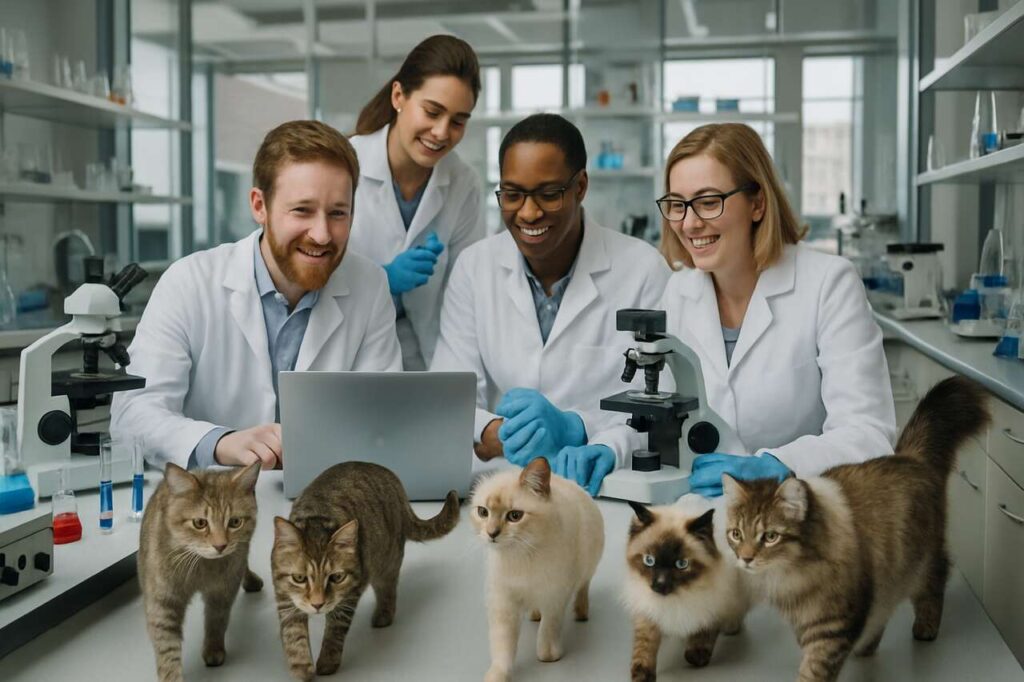
Domestic cats have long been cherished companions in households worldwide, yet their genetic makeup remains relatively unexplored compared to other domesticated animals. Researchers at Harvard are now spearheading an ambitious initiative to collect DNA samples from 100,000 cats to construct the world’s most comprehensive feline genetic database. This groundbreaking endeavour, known as the “Darwin’s Cats” project, seeks to unlock the mysteries surrounding cat ancestry, behaviour, and health through citizen science, inviting cat owners globally to contribute to this scientific milestone.
The collaboration between Harvard and cat owners
A pioneering citizen science initiative
The “Darwin’s Cats” project represents a unique partnership between academic researchers and the general public. Unlike traditional scientific studies that require specialised training or laboratory access, this initiative welcomes participation from anyone who owns a cat. The collaborative model democratises scientific research, transforming everyday pet owners into valuable contributors to genomic science. By involving citizens directly, the project not only accelerates data collection but also fosters public engagement with scientific inquiry.
How cat owners can participate
Participation in this research involves two straightforward components:
- Completing entertaining surveys about their cats’ personalities, behaviours, and physical characteristics
- Optionally submitting a fur sample from their feline companion
- Providing information about their cat’s breed, age, and health history
- Sharing observations about unique behavioural traits or quirks
This accessible approach ensures that no special qualifications are necessary, making the project inclusive and appealing to a broad audience of cat enthusiasts. The simplicity of the participation process has already attracted thousands of contributors since the project’s launch in mid-2024.
The success of this collaborative model hinges on the willingness of cat owners to engage with scientific research, setting the stage for understanding what the project aims to achieve through this massive data collection effort.
The objectives of the largest feline genetic database
Addressing a significant knowledge gap
Cats remain among the least studied domesticated animals in terms of genetics, despite their popularity as household pets. While extensive genetic databases exist for dogs, horses, and livestock, feline genomics has received comparatively limited attention. This project seeks to rectify this imbalance by creating a resource that rivals or surpasses existing databases for other species. The chief scientist at Darwin’s Ark emphasises that collecting comprehensive data is essential for advancing our understanding of cats across multiple dimensions.
Key research goals
The database aims to illuminate several critical areas:
| Research Area | Objective |
|---|---|
| Ancestry | Tracing evolutionary pathways and breed development |
| Behaviour | Identifying genetic markers associated with personality traits |
| Health | Discovering predispositions to diseases and conditions |
| Adaptation | Understanding how cats have evolved alongside humans |
By assembling genetic information from 100,000 cats, researchers hope to identify patterns and correlations that would be impossible to detect in smaller sample sizes. The ambitious target of reaching this milestone by 2026 reflects the project’s commitment to comprehensive data collection.
Understanding these genetic foundations naturally leads to questions about how such knowledge can explain the complex and often mysterious behaviours exhibited by our feline companions.
The importance of understanding cat behaviour
Linking genetics to personality
One of the most intriguing aspects of the project involves exploring the genetic basis of behaviour. Cat owners frequently observe vast differences in temperament between individual animals, from sociable and playful cats to more reserved and independent personalities. The research aims to determine whether these behavioural variations have genetic underpinnings or result primarily from environmental factors. Such insights could revolutionise how we understand feline psychology and improve human-cat relationships.
Practical applications for cat welfare
Understanding the genetic components of behaviour offers several practical benefits:
- Helping prospective owners select cats whose temperaments match their lifestyles
- Developing more effective training and socialisation strategies
- Identifying cats at risk for anxiety or aggression issues
- Improving shelter adoption outcomes through better personality matching
- Creating targeted interventions for behavioural problems
The surveys completed by participants provide rich contextual information that complements the genetic data, creating a holistic picture of each cat’s characteristics. This combination of genetic and observational data represents a powerful tool for unravelling the complexities of feline behaviour.
The ability to collect and analyse such vast amounts of genetic information depends heavily on recent innovations in scientific methodology and technology.
Technological advances in genetic research
Non-invasive DNA collection methods
A significant breakthrough enabling this project is the development of non-invasive DNA collection from fur samples. Traditional genetic sampling methods, such as buccal swabs or blood draws, often prove stressful for cats and challenging for owners to perform. The fur-based approach offers numerous advantages:
- No veterinary visit required
- Minimal stress for the animal
- Simple collection process for owners
- Reduced costs compared to clinical sampling
- Higher participation rates due to convenience
This innovative technique has already facilitated the analysis of genetic data from over 3,000 cats, demonstrating its viability for large-scale research. The simplicity of fur collection removes barriers that might otherwise prevent cat owners from participating.
Analytical capabilities and data processing
The vertebrate genomics group at the institutions involved possesses sophisticated analytical tools capable of processing enormous datasets. Advanced sequencing technologies and computational methods allow researchers to identify genetic variations, trace evolutionary relationships, and correlate genetic markers with observable traits. These technological capabilities transform raw DNA samples into meaningful scientific insights, making the ambitious scope of the project feasible.
While technology provides the tools, the human element remains indispensable to the project’s success, particularly the active involvement of those who know their cats best.
The role of owners in the study
Contributing observational expertise
Cat owners possess invaluable knowledge about their pets that no laboratory test can replicate. Daily interactions provide insights into personality quirks, behavioural patterns, health changes, and social dynamics that only emerge through long-term observation. The surveys designed for participants capture this experiential knowledge, creating a rich dataset that contextualises the genetic findings. Owners effectively serve as field researchers, documenting their cats’ lives in ways that complement the molecular data.
Empowering public participation in science
The project exemplifies how citizen science can democratise research and engage broader communities in scientific discovery. Benefits of this approach include:
- Increasing public scientific literacy
- Fostering appreciation for research methodologies
- Creating personal investment in scientific outcomes
- Expanding data collection capabilities beyond traditional constraints
- Building connections between academic institutions and the public
Participants gain the satisfaction of contributing to genuine scientific research whilst potentially learning more about their own cats. This mutual benefit strengthens the relationship between researchers and the community, creating a sustainable model for future studies.
The knowledge generated through this collaborative effort promises to extend far beyond academic interest, potentially transforming how we approach feline health and veterinary care.
Future implications for feline health
Identifying disease predispositions
One of the most significant potential outcomes involves discovering genetic markers associated with feline diseases. Many cats suffer from conditions such as hypertrophic cardiomyopathy, kidney disease, diabetes, and various cancers. Understanding the genetic basis of these conditions could enable:
| Application | Impact |
|---|---|
| Early screening | Detecting at-risk cats before symptoms appear |
| Preventive care | Implementing lifestyle modifications to reduce disease risk |
| Breeding decisions | Reducing hereditary disease prevalence in pedigree lines |
| Targeted therapies | Developing treatments based on genetic profiles |
Such advances could dramatically improve feline longevity and quality of life, whilst potentially reducing veterinary costs for owners through earlier intervention and prevention.
Broader scientific contributions
Beyond immediate veterinary applications, the database may yield insights relevant to comparative genomics and evolutionary biology. Cats share many physiological systems with humans and other mammals, making them valuable models for understanding broader biological principles. The project’s findings could inform research into mammalian evolution, domestication processes, and the genetic basis of complex traits across species. The ambitious timeline to reach 100,000 samples by 2026 reflects the urgency researchers feel about building this comprehensive resource.
The “Darwin’s Cats” project represents a remarkable convergence of scientific ambition, technological innovation, and public engagement. By harnessing the collective power of cat owners worldwide, researchers are constructing an unprecedented genetic resource that promises to transform our understanding of feline biology. The project demonstrates how citizen science can accelerate research whilst fostering public connection to scientific discovery. As the database grows towards its goal, the potential for breakthroughs in feline health, behaviour, and evolutionary history expands proportionally. This initiative not only advances our knowledge of cats but also models a collaborative approach to research that could be replicated across other fields, ultimately benefiting both animals and the humans who cherish them.