



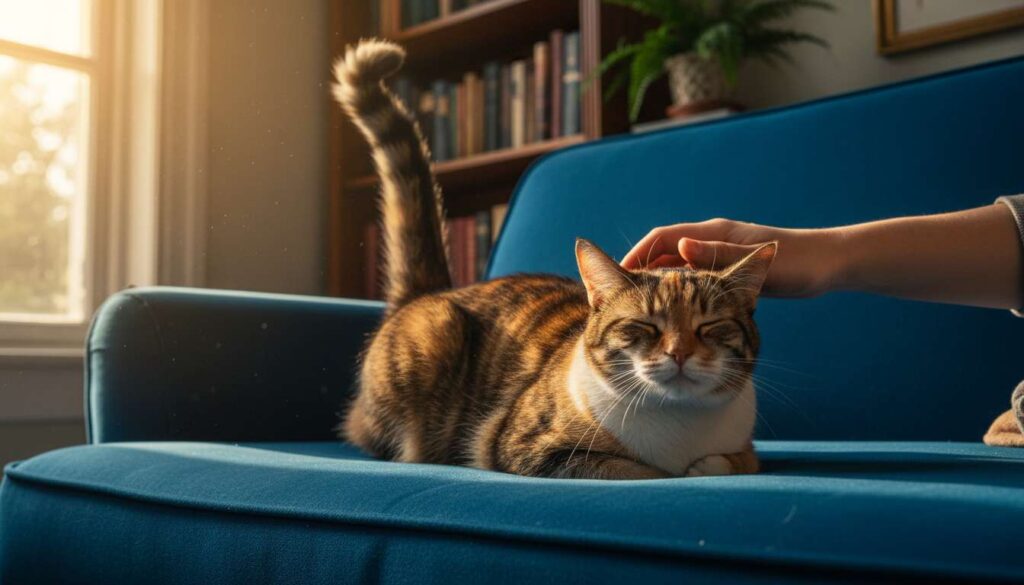
Cats communicate with us in numerous ways, and one of the most expressive tools they possess is their tail. When your feline companion raises its tail whilst being stroked, this gesture carries significant meaning. Understanding this behaviour provides valuable insight into your cat’s emotional state and helps strengthen the bond between you and your pet. Decoding these subtle signals transforms everyday interactions into meaningful exchanges of trust and affection.
Understanding cat tail language
The anatomy of feline communication
Cats possess a sophisticated communication system that relies heavily on body language rather than vocalisation. The tail serves as a crucial element in this non-verbal repertoire, functioning both as a balance mechanism and a communication tool. Comprising numerous vertebrae and muscles, the tail offers remarkable flexibility and control, enabling cats to convey a wide range of emotions and intentions through subtle movements and positions.
Key tail positions and their meanings
Recognising different tail positions helps owners interpret their cat’s mood accurately. The following positions represent the most common tail language signals:
- Vertical tail: indicates confidence, contentment and friendliness
- Curved tip: suggests a particularly happy and approachable mood
- Low-hanging tail: signals uncertainty, fear or submission
- Puffed-up tail: demonstrates fear, aggression or extreme agitation
- Wrapped around body: shows anxiety or defensive behaviour
The importance of context
Interpreting tail language requires consideration of the surrounding circumstances. A raised tail during petting carries different implications than the same position during play or feeding time. Observing your cat’s overall body posture, including ear position, eye dilation and whisker orientation, provides a complete picture of their emotional state. This holistic approach ensures accurate interpretation and appropriate responses to your cat’s needs.
Recognising these fundamental aspects of tail communication sets the foundation for understanding more specific behaviours, particularly the significance of a raised tail during stroking sessions.
Why do cats raise their tails ?
Evolutionary origins of tail raising
The behaviour of raising tails has evolutionary roots in feline social structures. In wild cat colonies, tail position serves as a visual signal that can be observed from a distance. Kittens learn to raise their tails when approaching their mother, facilitating recognition and encouraging grooming behaviour. This instinctive gesture carries forward into domestic life, where cats transfer this maternal association to their human caregivers.
Trust and vulnerability
When a cat raises its tail during petting, it exposes its rear area, which represents a vulnerable body part. This deliberate display of vulnerability demonstrates profound trust in the person providing the attention. Cats are naturally cautious creatures who protect their sensitive areas from potential threats. By raising the tail, your cat communicates that it perceives you as safe, trustworthy and non-threatening.
Scent communication
Raising the tail serves a practical purpose in scent exchange. Cats possess scent glands around their anal region, and elevating the tail allows for better distribution of their personal scent. This behaviour facilitates identification and social bonding within feline groups. When your cat raises its tail whilst being stroked, it may be attempting to share its scent with you, marking you as part of its social circle.
| Behaviour | Primary purpose | Emotional state |
|---|---|---|
| Tail raised vertically | Greeting and trust display | Happy and confident |
| Tail raised with curved tip | Friendly approach invitation | Playful and affectionate |
| Tail raised whilst being stroked | Trust and comfort expression | Relaxed and content |
Beyond the simple act of raising the tail, the specific movements and positions provide additional layers of meaning worth exploring in greater detail.
Interpreting tail movements
Dynamic versus static positions
A raised tail can remain stationary or exhibit various movements, each conveying different messages. A still, vertical tail typically indicates calm contentment, whilst gentle swaying suggests relaxed happiness. Rapid movements or twitching whilst the tail remains elevated may signal growing excitement or mild irritation, prompting owners to adjust their interaction accordingly.
The quivering tail phenomenon
Some cats exhibit a distinctive quivering motion when their tail is raised, particularly during greetings or petting sessions. This trembling movement represents an intense expression of joy and affection. Cats displaying this behaviour are experiencing strong positive emotions and demonstrating their pleasure in the interaction. This quiver should not be confused with the aggressive tail lashing that occurs when cats feel threatened.
Combination signals
Tail language rarely occurs in isolation. Cats combine tail positions with other body language elements to create comprehensive messages:
- Raised tail with purring: maximum contentment and trust
- Raised tail with slow blinking: affection and relaxation
- Raised tail with kneading: deep comfort and happiness
- Raised tail with rubbing: scent marking and bonding behaviour
Understanding these nuanced movements helps owners respond appropriately to their cat’s emotional needs and preferences during interactive moments.
Emotional significance of a raised tail
Happiness and contentment indicators
A raised tail during stroking primarily signals positive emotions. This posture indicates that your cat finds the interaction pleasurable and wishes it to continue. The elevated tail position reflects emotional security, suggesting your cat feels safe enough to express vulnerability and enjoyment openly. This behaviour often accompanies purring, relaxed body posture and half-closed eyes, creating a complete picture of feline contentment.
Social bonding expression
The raised tail serves as a bonding mechanism between cats and their human companions. By adopting this posture during petting, cats acknowledge the relationship and reinforce social connections. This behaviour mirrors interactions between friendly cats in multi-cat households, where tail raising facilitates peaceful coexistence and mutual grooming sessions. Your cat essentially treats you as a trusted member of its social group.
Confidence and security
Tail elevation during stroking demonstrates emotional confidence. Anxious or insecure cats typically keep their tails low or tucked between their legs. A raised tail indicates that your cat feels secure in its environment and comfortable with the physical contact. This confidence extends beyond the immediate interaction, reflecting the overall quality of your relationship and the cat’s general wellbeing within your home.
Recognising these emotional dimensions helps owners appreciate the depth of their cat’s communication and informs appropriate responses to this behaviour.
What to do when your cat raises its tail
Responding appropriately to the signal
When your cat raises its tail during petting, the most appropriate response involves continuing the interaction in a manner your cat finds enjoyable. Focus on areas cats typically appreciate, such as the base of the ears, cheeks and chin. Avoid suddenly touching the tail itself, as many cats find this uncomfortable despite raising it. Respect your cat’s preferences and watch for additional body language cues indicating pleasure or discomfort.
Areas to avoid
Whilst a raised tail signals trust, it does not necessarily constitute an invitation to touch all body parts. Many cats remain sensitive about certain areas:
- The tail itself: often sensitive and best left untouched
- The belly: despite appearing relaxed, most cats dislike belly rubs
- The paws: typically sensitive and reserved for self-grooming
- The rear area: exposed but not necessarily welcoming touch
Duration and intensity considerations
Even when displaying positive signals, cats have interaction limits. Watch for subtle changes in body language that indicate your cat has had sufficient attention. These signs include tail position lowering, ear rotation backwards, or skin rippling along the back. Respecting these boundaries prevents overstimulation and maintains the positive association with petting sessions.
Building on these responsive techniques, owners can develop broader strategies for enhancing communication with their feline companions.
Tips for improving communication with your cat
Observation and patience
Developing strong communication with your cat requires consistent observation and patience. Spend time watching your cat’s behaviour in various situations, noting how tail positions correlate with different emotional states. This knowledge enables you to anticipate your cat’s needs and respond appropriately. Remember that each cat possesses unique personality traits and communication styles requiring individualised interpretation.
Creating positive associations
Strengthen your bond by ensuring interactions remain positive experiences. When your cat raises its tail during petting, reward this trust with gentle, appropriate attention. Avoid forcing interactions when your cat displays closed body language. This approach builds confidence and encourages your cat to communicate openly through tail language and other signals.
Consistency in responses
Cats thrive on predictable patterns. Respond consistently to your cat’s tail signals, reinforcing their communication efforts. If your cat raises its tail seeking attention, acknowledge this gesture regularly. Consistent responses help your cat understand that its communication proves effective, encouraging continued use of these signals.
Understanding and responding appropriately to your cat’s tail language transforms everyday interactions into meaningful exchanges. When your cat raises its tail during stroking, it offers a gesture of trust and contentment that deserves recognition and respect. By observing context, interpreting movements accurately and responding sensitively, you strengthen the bond with your feline companion. This enhanced communication creates a harmonious relationship built on mutual understanding and respect, enriching both your lives through deeper connection and trust.