


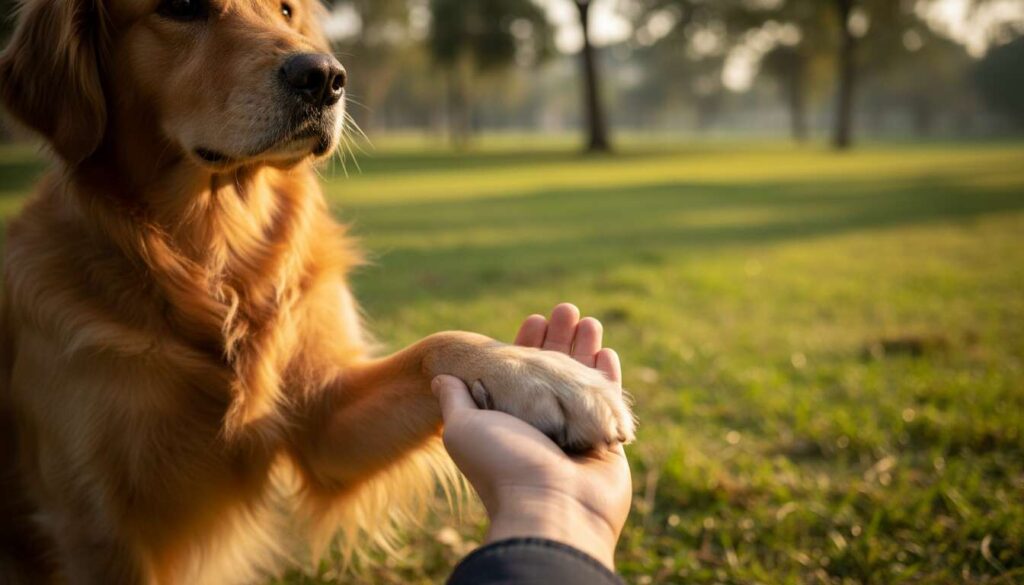
When your dog gently places a paw on your knee or nudges your hand with their foot, it’s easy to assume this gesture stems from love or obedience. Yet animal behaviourists suggest the reality is far more nuanced. This seemingly simple act carries multiple meanings, shaped by context, individual personality, and the specific relationship between dog and owner. Understanding what lies behind this common canine gesture can transform how we interpret and respond to our four-legged companions.
Why does my dog put its paw on me ?
The act of a dog placing its paw on a human is one of the most frequent forms of physical communication in the canine repertoire. Unlike vocalisation, which can be ambiguous, this tactile gesture represents a deliberate attempt at interaction. Dogs learn early in life that physical contact with humans often yields results, whether that means receiving food, attention, or comfort.
The evolutionary basis of pawing behaviour
From puppyhood, dogs discover that touch prompts responses from their mothers and littermates. This instinctive communication method transfers naturally to human relationships. When a puppy paws at its mother for milk, it learns a fundamental lesson: physical contact generates reaction. This behaviour becomes reinforced throughout the dog’s life, particularly when owners respond positively to pawing gestures.
Research into canine development shows that dogs retain juvenile behaviours into adulthood when living with humans, a phenomenon known as neoteny. Pawing represents one such retained trait, serving as a bridge between canine and human communication systems.
Individual variation in pawing frequency
Not all dogs paw with equal frequency. Several factors influence this behaviour:
- breed characteristics and temperament
- early socialisation experiences
- owner responses to previous pawing attempts
- the dog’s general confidence level
- learned associations between pawing and rewards
Breeds developed for close human cooperation, such as retrievers and spaniels, tend to exhibit more frequent pawing than independent breeds like hounds or terriers. However, individual personality often overrides breed tendencies.
Understanding why dogs paw naturally leads to examining the specific motivations driving this behaviour in different contexts.
The reasons behind this behaviour
Pawing serves multiple functions in canine communication, each reflecting different emotional states and intentions. Recognising these distinctions enables owners to respond appropriately rather than applying a one-size-fits-all interpretation.
Communication and request signalling
Dogs are remarkably adept at associating specific actions with desired outcomes. When a dog learns that pawing at the door results in being let outside, or that touching your arm during dinner yields scraps, this behaviour becomes a purposeful communication tool. This represents neither affection nor submission but rather practical problem-solving.
| Context | Likely meaning | Accompanying signals |
|---|---|---|
| Near food bowl | Hunger or thirst | Looking between owner and bowl |
| By the door | Need to toilet or desire for walk | Restlessness, whining |
| During petting | Request to continue | Relaxed body, soft eyes |
| When owner is busy | Attention seeking | Persistence, vocalisation |
Stress relief and self-soothing
Not all pawing indicates a request. Some dogs paw when experiencing anxiety or uncertainty, using the gesture as a coping mechanism. This behaviour often appears during thunderstorms, fireworks, or when left alone. The physical contact with a trusted human provides reassurance, similar to how a child might reach for a parent’s hand in unfamiliar situations.
Dogs may also paw as a displacement behaviour when facing conflicting emotions, such as wanting to approach something whilst simultaneously feeling apprehensive.
Whilst these general motivations provide a framework, one particular use of pawing deserves closer examination.
The paw for attracting attention
Perhaps the most common reason dogs employ pawing is to capture human attention. This learned behaviour develops through repeated reinforcement cycles that most owners inadvertently create.
How attention-seeking pawing develops
The pattern typically unfolds as follows: a dog paws at an owner, the owner responds by looking at, speaking to, or touching the dog, and the dog learns that pawing reliably generates interaction. Even negative attention, such as pushing the dog away or saying “no”, reinforces the behaviour because it still constitutes a response.
This creates a self-perpetuating cycle where dogs increasingly rely on pawing to initiate contact, particularly if they’ve discovered that persistence eventually succeeds.
Distinguishing genuine needs from habit
Owners face the challenge of determining whether pawing signals a legitimate requirement or simply represents habitual attention-seeking. Key indicators include:
- timing in relation to routine activities like feeding or walks
- the dog’s recent activity level and stimulation
- whether basic needs have been met
- consistency of the behaviour across different situations
A dog that paws immediately after a long walk and full meal likely seeks attention rather than expressing an unmet need. Conversely, pawing accompanied by signs of discomfort or distress warrants immediate investigation.
Yet attention-seeking represents only one dimension of this complex gesture, particularly when considering its emotional components.
Relation between raised paw and affection
The notion that pawing automatically signals love oversimplifies canine emotional expression. Whilst affection can certainly motivate this behaviour, the connection is less straightforward than commonly assumed.
Affection versus social bonding
Dogs are social animals that naturally seek proximity and interaction with their pack members, whether canine or human. Pawing during relaxed moments, such as whilst sitting together on the sofa, often reflects this social bonding instinct rather than what humans conceptualise as romantic or familial love.
The behaviour serves to maintain social connection and reinforce pack cohesion, functions that existed long before dogs became domesticated. When your dog paws you during quiet moments, they’re engaging in behaviour that wild canids use to strengthen group bonds.
Reading emotional context
True affectionate pawing typically occurs alongside other positive signals:
- relaxed body posture with loose muscles
- soft, squinting eyes
- gently wagging tail at mid-height
- calm breathing patterns
- leaning into rather than away from contact
When these signals accompany pawing, the gesture likely carries positive emotional content. However, the same physical action performed with tense muscles, dilated pupils, or a tucked tail suggests entirely different motivations.
This complexity highlights why understanding canine behaviour requires looking beyond individual gestures to broader patterns.
The dog’s limits: testing and understanding
Pawing sometimes represents a dog’s attempt to establish boundaries or test the parameters of their relationship with humans. This aspect of the behaviour often goes unrecognised but plays a crucial role in canine social dynamics.
Boundary testing through physical contact
Dogs constantly assess their position within household hierarchies. Pawing can function as a gentle probe to determine acceptable behaviour limits. A dog that paws persistently despite being asked to stop may be testing whether commands are consistently enforced.
This doesn’t indicate dominance in the outdated alpha-theory sense, but rather reflects normal social learning. Dogs need to understand household rules, and pawing provides a low-risk method for exploring those boundaries.
When pawing becomes problematic
Excessive or demanding pawing may indicate:
| Behaviour pattern | Possible underlying issue | Recommended response |
|---|---|---|
| Constant pawing regardless of situation | Insufficient mental stimulation | Increase enrichment activities |
| Aggressive pawing with vocalisation | Frustration or resource guarding | Consult professional behaviourist |
| Pawing only specific family members | Inconsistent boundary enforcement | Establish unified household rules |
| Anxious pawing with trembling | Separation anxiety or fear | Address underlying anxiety causes |
Recognising when pawing crosses from normal communication into problematic territory allows owners to address issues before they become entrenched habits.
Rather than viewing pawing as something to eliminate, owners can harness this natural behaviour to enhance their relationship.
Strengthening the bond with your dog through pawing
Understanding pawing’s true meanings creates opportunities to deepen the human-canine connection through informed responses and mutual communication.
Responding appropriately to pawing
Effective responses depend on accurately reading context and motivation. When pawing seeks attention during appropriate times, responding positively reinforces healthy communication. When it demands attention during inappropriate moments, calmly ignoring the behaviour teaches discrimination.
The key lies in consistency. All household members should respond similarly to pawing, preventing confusion about acceptable behaviour patterns.
Teaching alternative communication methods
Whilst pawing represents natural canine communication, teaching additional signals expands your dog’s vocabulary:
- training specific behaviours for different needs (sitting by the door for toilet breaks)
- using buttons or bells for clear communication
- rewarding calm attention-seeking over demanding pawing
- establishing routine schedules that reduce need-based pawing
These alternatives don’t replace pawing but rather provide dogs with a broader communication toolkit, reducing frustration on both sides.
Embracing pawing as dialogue
Rather than viewing pawing as a behaviour to control or eliminate, recognising it as part of your dog’s communication repertoire transforms the interaction. Each paw placement becomes an opportunity for connection, understanding, and response.
This perspective shift moves the relationship from one of command-and-obey to genuine interspecies dialogue, where both parties actively participate in mutual understanding.
The simple act of a dog placing their paw on you contains layers of meaning that extend far beyond love or obedience. This gesture serves as request, reassurance, social bonding, and boundary exploration depending on context and individual dog. By observing accompanying body language, considering circumstances, and responding thoughtfully, owners can decode these messages accurately. Rather than applying singular interpretations, recognising pawing’s complexity enriches our relationships with canine companions, transforming a common gesture into meaningful conversation. Understanding what your dog truly communicates through their paw creates opportunities for deeper connection built on mutual comprehension rather than assumption.