



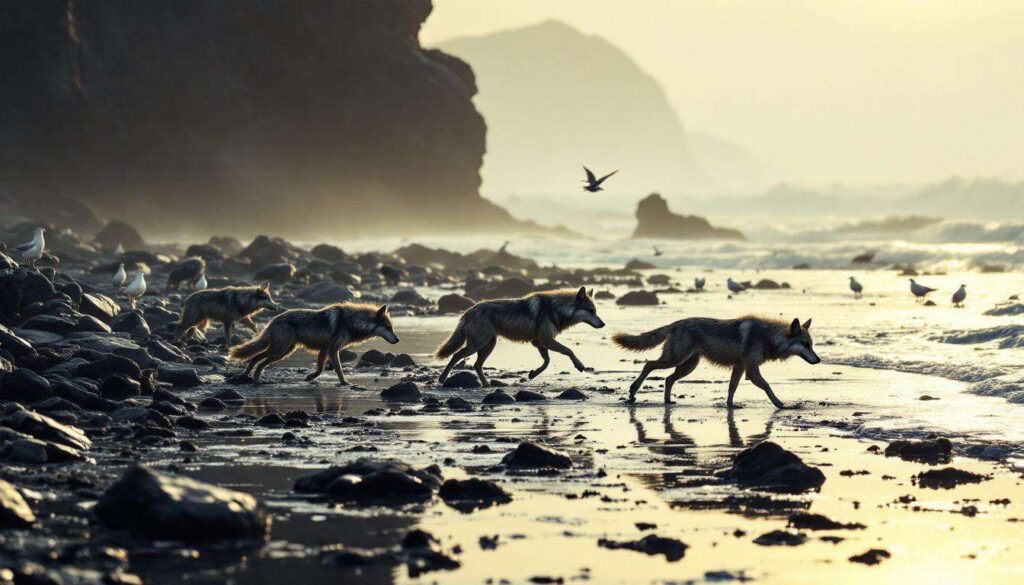
Researchers studying coastal gray wolves in North America have uncovered hunting patterns that challenge conventional understanding of these apex predators. Along remote shorelines where forest meets ocean, these wolves demonstrate behaviours that distinguish them markedly from their inland counterparts. Their dietary preferences and foraging strategies reveal a remarkable adaptability that scientists are only beginning to comprehend fully. These discoveries raise important questions about predator-prey dynamics in coastal environments and the cascading effects such behaviours may trigger throughout interconnected ecosystems.
Unusual hunting behaviour: recent revelations
Coastal gray wolves inhabit a narrow ecological niche along the Pacific coastline, where they have developed distinctive hunting patterns that set them apart from inland populations. Field observations have documented these wolves actively foraging along tidal zones, a behaviour rarely observed in traditional wolf populations.
Documented observations in coastal regions
Scientists equipped with camera traps and GPS tracking collars have recorded wolves patrolling beaches during low tide periods, systematically searching for marine resources. These wolves demonstrate temporal coordination with tidal cycles, suggesting learned behaviours passed between generations. Research teams have observed individual wolves spending considerable time along shorelines, sometimes travelling several kilometres of coastline in a single foraging expedition.
The wolves exhibit patience and precision when hunting in these environments, behaviours that differ substantially from the pursuit-based strategies employed when hunting terrestrial ungulates. This coastal specialisation appears concentrated in specific wolf populations, indicating localised cultural transmission of hunting knowledge within family groups.
Departure from traditional wolf hunting patterns
Traditional wolf hunting relies heavily on cooperative pack strategies to bring down large prey such as deer, elk, or moose. Coastal wolves, however, frequently hunt individually or in pairs when targeting marine resources. This represents a significant behavioural shift that challenges assumptions about wolf social hunting requirements.
Key differences include:
- Reduced reliance on pack coordination for certain prey types
- Increased solitary foraging behaviour during tidal periods
- Flexible hunting schedules aligned with environmental conditions rather than prey movement patterns
- Opportunistic feeding strategies that complement traditional hunting
These adaptations suggest that coastal wolves possess greater behavioural plasticity than previously recognised, raising questions about how other wolf populations might adapt to changing environmental conditions.
Understanding what these wolves actually consume provides crucial context for interpreting their unusual behaviours.
The prey targeted by coastal wolves
The dietary composition of coastal wolves reveals a surprisingly diverse menu that extends well beyond typical wolf prey species. Analysis of scat samples, stable isotope studies, and direct observations have documented an unexpected reliance on marine resources.
Marine species in wolf diets
Researchers have identified numerous marine species in coastal wolf diets, including:
- Salmon during spawning runs
- Seal carcasses washed ashore
- Various shellfish species harvested from tidal pools
- Seabirds and their eggs from nesting colonies
- Marine invertebrates including crabs and sea urchins
Stable isotope analysis indicates that marine resources can constitute up to 25% of dietary intake in some coastal wolf populations, a proportion that fluctuates seasonally. During salmon spawning periods, this percentage may increase dramatically as wolves capitalise on abundant, easily accessible protein sources.
Seasonal variations in prey selection
Coastal wolves demonstrate remarkable dietary flexibility across seasons. During spring and summer months, when salmon runs occur, wolves concentrate their efforts along spawning streams. Autumn brings different opportunities as seals haul out on beaches, and winter storms deposit marine carrion along shorelines.
| Season | Primary prey | Hunting location |
|---|---|---|
| Spring | Salmon, deer | Streams, forest |
| Summer | Salmon, seabirds | Rivers, coastal cliffs |
| Autumn | Seal carrion, ungulates | Beaches, inland areas |
| Winter | Marine carrion, deer | Shorelines, forest |
This seasonal rotation allows coastal wolves to maintain nutritional intake even when terrestrial prey becomes scarce, demonstrating an adaptive strategy that buffers against resource fluctuations.
The methods these wolves employ to capture such varied prey reveal equally fascinating adaptations.
Unique hunting techniques and emerging strategies
Coastal wolves have developed specialised techniques for exploiting marine resources, behaviours that appear to be learned and refined through experience rather than instinctive.
Tidal zone foraging methods
Wolves hunting in tidal zones display systematic search patterns, investigating rock pools, kelp beds, and exposed reef structures. They use their keen sense of smell to locate buried shellfish and employ their powerful jaws to crack open shells. Some individuals have been observed digging in sandy substrates to uncover clams and other burrowing invertebrates.
During salmon runs, wolves position themselves at strategic locations along streams where fish congregate in shallow water. They employ quick strikes to catch fish, a technique requiring different motor skills than those used when hunting terrestrial prey.
Cooperative versus solitary approaches
While pack hunting remains important for taking down large ungulates, coastal wolves frequently adopt solitary strategies when exploiting marine resources. This flexibility suggests that social hunting requirements may be prey-specific rather than obligatory for all foraging activities.
However, during abundant salmon runs, multiple wolves may fish simultaneously in proximity, though without the coordinated tactics observed during ungulate hunts. This represents a middle ground between truly cooperative hunting and completely independent foraging.
These novel hunting behaviours inevitably influence the broader ecological community in which these wolves operate.
Unexpected impacts on the local ecosystem
The foraging activities of coastal wolves generate ripple effects throughout their ecosystems, affecting species and processes in ways researchers are still working to quantify.
Effects on prey populations
Wolf predation on salmon may influence nutrient distribution patterns, as wolves transport marine-derived nutrients inland when they cache fish or defecate after consuming them. This creates nutrient subsidies for terrestrial vegetation, potentially enhancing forest productivity in coastal zones.
Impacts on other prey populations remain less clear. Wolves consuming seal carrion may reduce food availability for scavengers such as ravens, eagles, and bears, potentially intensifying competition among these species.
Broader ecological consequences
Potential ecosystem impacts include:
- Altered scavenger community dynamics due to competition for marine carrion
- Changes in nutrient cycling between marine and terrestrial environments
- Possible effects on vegetation through nutrient deposition patterns
- Shifts in prey species behaviour in response to wolf presence in novel habitats
These cascading effects underscore the complexity of coastal ecosystems and highlight how apex predator behaviours can influence ecological processes across habitat boundaries.
Such ecological complexity necessitates careful consideration in management approaches.
Implications for conservation and species management
The discovery of these unique coastal wolf behaviours presents both opportunities and challenges for wildlife managers and conservation practitioners.
Protected habitat considerations
Traditional wolf conservation has focused primarily on protecting inland forest habitats and ensuring adequate ungulate prey populations. Coastal wolves require a different approach that recognises the importance of shoreline access and marine resource availability. Conservation strategies must therefore encompass both terrestrial and coastal zones to maintain the full spectrum of resources these wolves utilise.
Management strategy adjustments
Wildlife managers may need to reconsider population monitoring methods, as coastal wolves may range more extensively along shorelines than inland wolves do within forest territories. Understanding seasonal movements between coastal and inland areas becomes crucial for accurate population assessments.
Furthermore, human activities along coastlines, including development, recreation, and resource extraction, may disproportionately affect coastal wolf populations by restricting access to critical foraging areas during key seasons.
Continued scientific investigation will prove essential for developing effective conservation frameworks.
Future prospects and further research
Numerous questions remain regarding coastal wolf ecology and the long-term sustainability of their unique hunting strategies.
Research priorities
Scientists have identified several critical research needs:
- Long-term dietary studies to quantify seasonal and annual variation in marine resource dependence
- Genetic analyses to determine whether coastal populations show adaptations related to their specialised diets
- Behavioural studies examining how hunting techniques are transmitted between generations
- Ecosystem modelling to predict how changes in marine or terrestrial prey availability might affect wolf populations
Climate change considerations
Climate change may significantly impact coastal wolf populations by altering salmon run timing, affecting seal distributions, and changing tidal zone productivity. Understanding current behaviours provides a baseline against which future changes can be measured, making ongoing research particularly valuable for adaptive management in changing environmental conditions.
The remarkable adaptability demonstrated by coastal gray wolves offers valuable insights into predator ecology and ecosystem functioning. Their unexpected hunting behaviours challenge traditional classifications of wolf populations and underscore the importance of recognising local adaptations in conservation planning. As research continues to reveal the ecological significance of these behaviours, management strategies must evolve to protect not only the wolves themselves but also the diverse habitats and prey resources upon which they depend. The coastal wolf story reminds us that even well-studied species can surprise us, revealing hidden complexity in the natural world that demands continued scientific attention and thoughtful stewardship.