



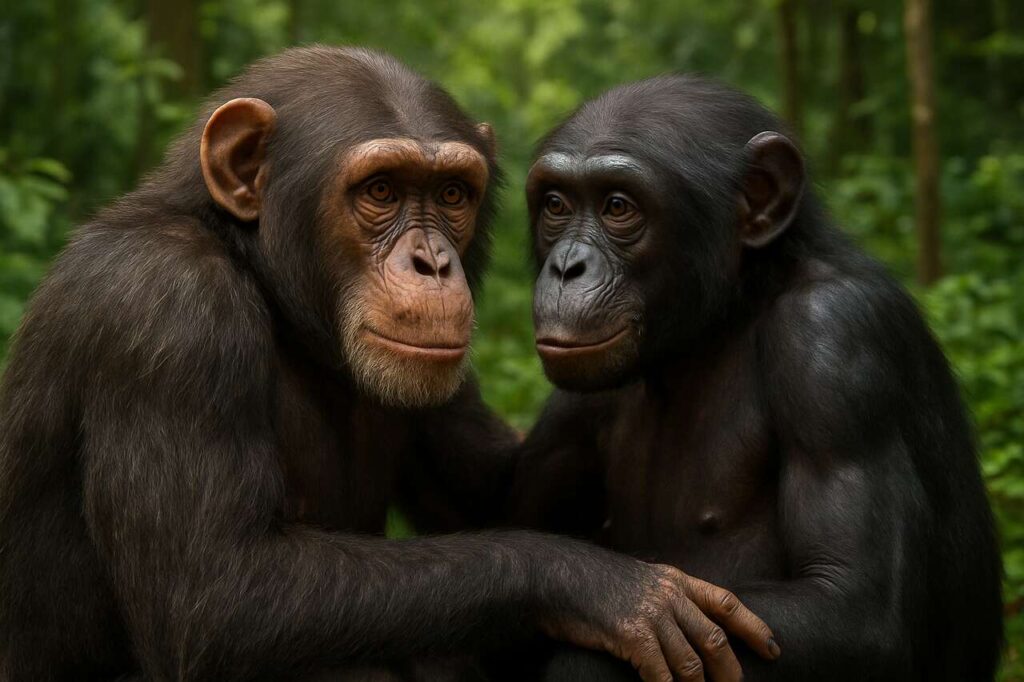
Recent scientific studies have uncovered remarkable parallels between human social structures and those of our closest evolutionary relatives. Researchers examining the behaviour of chimpanzees and bonobos have documented evidence suggesting these great apes maintain complex social networks that mirror the friendship circles observed in human societies. The findings challenge previous assumptions about the uniqueness of human social organisation and offer fresh insights into the evolutionary origins of our own social behaviours. By analysing interaction patterns, grooming habits, and group dynamics, scientists have identified striking similarities in how these primates form and maintain relationships throughout their lives.
Understanding social relationships among primates
The complexity of primate social structures
Primates exhibit sophisticated social systems that extend far beyond simple hierarchical arrangements. Within chimpanzee and bonobo communities, individuals form intricate webs of relationships characterised by varying degrees of closeness, cooperation, and mutual support. These connections are not random but follow discernible patterns that researchers have only recently begun to decode systematically.
The social landscape of great apes includes several distinct relationship types:
- Close affiliative bonds between specific individuals
- Coalitionary partnerships for mutual defence
- Grooming networks that reinforce social ties
- Maternal kinship groups that span generations
- Male alliances that influence group dynamics
Measuring social connections in the wild
Scientists employ quantitative methods to assess the strength and nature of primate relationships. By recording the frequency and duration of social interactions, researchers construct detailed maps of social networks within communities. These observations reveal that certain individuals consistently spend more time together, engage in mutual grooming, and provide support during conflicts, indicating the presence of preferential relationships that resemble human friendships.
Understanding these fundamental social structures provides the foundation for recognising how chimpanzees and bonobos organise their communities in ways that parallel human social organisation.
The similarities between social circles of chimpanzees and bonobos
Concentric layers of social intimacy
Both chimpanzees and bonobos demonstrate a pattern of layered social relationships remarkably similar to human friendship circles. Research indicates these primates maintain a small core group of close associates, surrounded by progressively larger circles of less intimate acquaintances. This structure mirrors the social framework that anthropologists have documented in human populations across diverse cultures.
| Social Layer | Typical Size | Interaction Frequency |
|---|---|---|
| Core friends | 3-5 individuals | Daily contact |
| Close associates | 10-15 individuals | Regular interaction |
| Wider network | 20-30 individuals | Occasional contact |
Gender differences in social bonding
Observations reveal distinct patterns in how male and female chimpanzees and bonobos form their social circles. Male chimpanzees typically develop strong bonds with other males, forming coalitions that serve political and territorial purposes. Female bonobos, conversely, often establish the most robust social networks within their communities, creating alliances that provide stability and reduce aggression.
These gender-specific patterns in social organisation raise important questions about the evolutionary pressures that have shaped friendship formation in both apes and humans.
The importance of friendship bonds for primate survival
Evolutionary advantages of social connections
Strong social bonds provide tangible survival benefits for chimpanzees and bonobos. Individuals with robust friendship networks enjoy greater access to resources, receive support during conflicts, and experience reduced stress levels. Females with close social ties demonstrate higher reproductive success, whilst males with strong alliances achieve better mating opportunities and greater longevity.
Cooperative behaviours and mutual support
The practical manifestations of primate friendships include numerous cooperative activities that enhance survival prospects:
- Sharing food resources with preferred associates
- Providing protection against aggression from other group members
- Offering comfort and reassurance during stressful situations
- Collaborating in territorial defence and resource acquisition
- Caring for offspring of close social partners
These behaviours demonstrate that friendship in great apes serves functional purposes that extend beyond mere social preference, pointing towards the adaptive value of maintaining close relationships.
Research methods: observing primate groups
Long-term field studies
Scientists conducting this research rely on extended observation periods spanning multiple years to accurately map social relationships. Researchers spend countless hours in the field, meticulously recording interactions between individuals and noting patterns in association, grooming, and cooperative behaviours. This longitudinal approach allows scientists to track how relationships develop, strengthen, or deteriorate over time.
Technological innovations in behavioural research
Modern studies incorporate advanced analytical tools to process vast quantities of observational data. Network analysis software enables researchers to visualise complex social structures and identify key individuals who serve as social hubs within their communities. Video recording technology permits detailed analysis of subtle social signals and interaction patterns that might escape notice during direct observation.
These methodological approaches have yielded unprecedented insights into the social lives of our closest relatives, revealing connections to our own evolutionary past.
Implications for human psychology and evolution
Shared evolutionary heritage
The discovery of friendship circles in chimpanzees and bonobos suggests these social patterns originated before the evolutionary divergence of humans from other great apes. This finding indicates that the human propensity for forming layered social networks may represent an ancient adaptation rather than a uniquely human innovation. Understanding these shared characteristics illuminates the deep evolutionary roots of human social psychology.
Insights into human social behaviour
Comparative studies of primate social structures offer valuable perspectives on human friendship formation and maintenance. The similarities observed across species suggest fundamental principles governing social bonding that transcend specific cultural contexts. These insights may inform approaches to understanding human social challenges, from loneliness to community cohesion.
Such comparative research opens new avenues for investigating animal cognition and social intelligence across species.
New perspectives on studying animal behaviour
Recognising cognitive complexity in non-human species
This research contributes to a paradigm shift in how scientists conceptualise animal cognition and social intelligence. Rather than viewing complex social relationships as exclusively human traits, researchers increasingly acknowledge the sophisticated mental capacities required for maintaining nuanced social networks in other species. This recognition has profound implications for animal welfare, conservation strategies, and ethical considerations regarding primate research.
Future research directions
The discovery of friendship circles in great apes raises numerous questions for future investigation. Researchers aim to explore whether similar patterns exist in other primate species and what specific cognitive abilities enable the formation and maintenance of these complex social structures. Additionally, scientists seek to understand how environmental factors and social pressures influence the size and composition of friendship networks across different populations.
The revelation that chimpanzees and bonobos maintain friendship circles comparable to those of humans fundamentally alters our understanding of primate social behaviour. These findings demonstrate that complex, layered social networks represent a shared heritage among great apes rather than a uniquely human characteristic. By illuminating the evolutionary origins of friendship and social bonding, this research enriches our comprehension of both animal behaviour and human psychology. As scientists continue to investigate the nuances of primate social relationships, we gain deeper appreciation for the cognitive sophistication and emotional depth of our closest evolutionary relatives, whilst simultaneously discovering more about ourselves.