



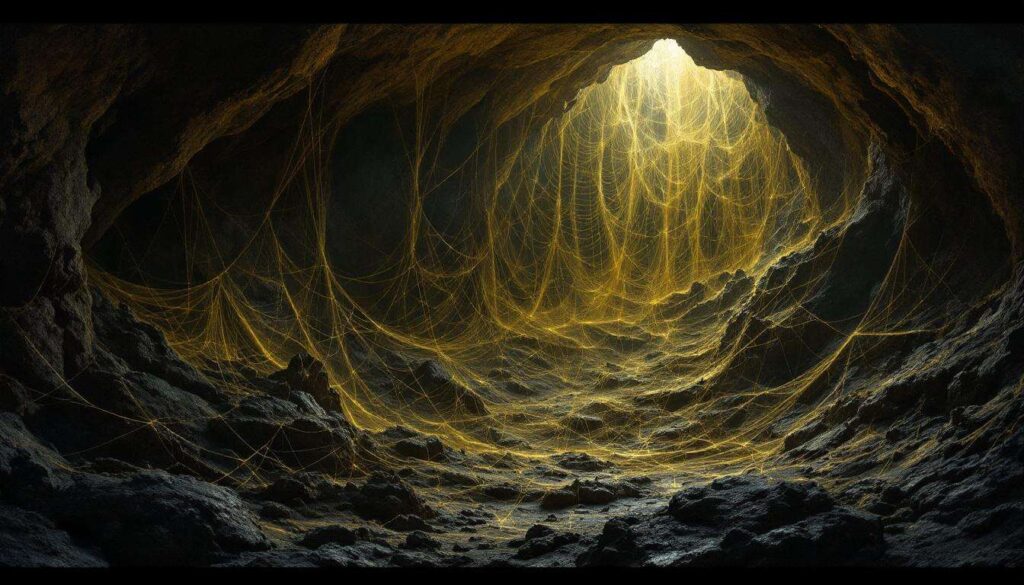
Deep within the secluded chambers of sulphur-rich caves, a remarkable discovery has sent ripples through the scientific community. Researchers have uncovered an extraordinary phenomenon: colonies of sulphur cave spiders constructing what appears to be an arachnid megacity, complete with what may constitute the largest spider web ever documented. This finding challenges previous understanding of spider behaviour and social organisation, revealing a level of complexity rarely observed in arachnid species.
Discovery of the mysterious sulphur cave spiders
The initial expedition and findings
The discovery occurred during a routine speleological survey in a remote cave system characterised by high sulphur concentrations and extreme environmental conditions. Researchers venturing into these inhospitable chambers encountered an unexpected sight: vast networks of silk stretching across cavern walls and ceilings, forming interconnected structures of unprecedented scale. The spiders responsible, previously unknown to science, demonstrated remarkable adaptations to their toxic environment.
Identifying the species
Taxonomic analysis revealed these arachnids belong to a previously undocumented lineage, exhibiting several distinctive features:
- Pale, almost translucent exoskeletons adapted to perpetual darkness
- Enhanced sensory organs compensating for minimal light conditions
- Specialised respiratory systems tolerating elevated sulphur dioxide levels
- Unusual social behaviours atypical of most spider species
The species has been provisionally classified within the family Nesticidae, though genetic sequencing suggests it may represent an entirely new taxonomic branch. Understanding these creatures’ evolutionary history provides crucial context for their extraordinary architectural achievements.
Formation of an arachnid metropolis
Collaborative construction techniques
Unlike most spider species, which operate as solitary hunters, sulphur cave spiders exhibit remarkable cooperative behaviour. Observations indicate that hundreds, possibly thousands, of individuals work in concert to construct their massive web structures. This collaboration involves distinct roles within the colony, with some spiders focusing on structural support whilst others specialise in creating capture threads.
Architectural complexity
The megacity structure comprises multiple interconnected zones, each serving specific functions:
| Zone Type | Primary Function | Approximate Coverage |
|---|---|---|
| Nursery chambers | Egg protection and juvenile development | 15-20% of total structure |
| Hunting platforms | Prey capture and processing | 40-50% of total structure |
| Communal areas | Social interaction and resource sharing | 20-25% of total structure |
| Retreat spaces | Individual shelter and moulting | 10-15% of total structure |
This functional differentiation demonstrates sophisticated spatial planning previously unrecognised in arachnid societies. The scale of these structures has prompted researchers to reconsider fundamental assumptions about spider cognitive capabilities and social organisation.
The unique characteristics of the webs
Record-breaking dimensions
Preliminary measurements suggest the largest continuous web structure spans approximately 200 square metres, potentially making it the most extensive spider web ever recorded. The silk network extends across multiple cave chambers, creating a three-dimensional matrix that maximises prey interception whilst maintaining structural integrity in the cave’s humid, chemically challenging environment.
Silk composition and properties
Analysis of the silk reveals extraordinary properties adapted to the sulphurous conditions:
- Enhanced resistance to chemical degradation from sulphur compounds
- Superior tensile strength compared to common garden spider silk
- Modified adhesive properties optimised for cave-dwelling prey
- Unusual protein structures conferring exceptional durability
These adaptations enable the webs to persist for extended periods despite the corrosive atmosphere, a feat impossible for silk produced by surface-dwelling species. The biomechanical properties of this silk have attracted considerable interest from materials scientists seeking inspiration for synthetic fibres.
Ecological impact and spider biology
Role within the cave ecosystem
The sulphur cave spiders occupy a crucial ecological niche within their subterranean habitat. As apex predators in this limited ecosystem, they regulate populations of cave-adapted insects, mites, and other arthropods. Their extensive web networks also provide substrate for microbial communities, contributing to nutrient cycling within the cave system.
Reproductive strategies and life cycle
Observations suggest these spiders employ cooperative brood care, with multiple females contributing to egg protection and juvenile feeding. This communal approach to reproduction represents a significant departure from typical spider behaviour and may explain the colony’s ability to maintain such large-scale structures across generations. Juvenile spiders appear to learn construction techniques through observation, suggesting cultural transmission of architectural knowledge.
Feeding behaviours and prey selection
The megacity structure functions as an extraordinarily efficient prey capture system. Cave-dwelling insects, attracted by moisture and organic matter, become ensnared in the extensive web network. The spiders demonstrate coordinated hunting responses, with multiple individuals converging on trapped prey to facilitate rapid subduing and processing.
Conservation and preservation issues
Threats to the habitat
Despite their remote location, sulphur cave spider colonies face several significant threats:
- Disturbance from increased speleological tourism and research activities
- Potential changes in cave microclimate due to external environmental shifts
- Contamination from surface pollutants infiltrating groundwater systems
- Risk of habitat destruction from mining or resource extraction
Protection measures and recommendations
Conservation biologists have proposed implementing strict access controls to the cave system, limiting entry to essential scientific personnel. Establishing the site as a protected geological and biological reserve would provide legal safeguards against commercial exploitation whilst permitting continued research under carefully managed conditions. Long-term monitoring programmes are essential for tracking colony health and detecting environmental changes that might threaten this unique ecosystem.
Implications for scientific research
Advancing arachnological understanding
This discovery fundamentally challenges existing models of spider social evolution and behaviour. The sulphur cave spiders demonstrate that under appropriate environmental pressures, arachnids can develop complex social structures rivalling those of social insects. This finding opens new avenues for investigating the evolutionary pathways leading to cooperative behaviour in traditionally solitary organisms.
Biomimetic applications
The exceptional properties of sulphur cave spider silk present opportunities for developing novel materials with applications in medicine, engineering, and manufacturing. Researchers are particularly interested in understanding how the silk maintains integrity in chemically aggressive environments, knowledge that could inform the design of protective coatings and durable textiles.
Future research directions
Scientists have identified several priority areas for continued investigation, including detailed genetic analysis to understand the evolutionary origins of this species, comprehensive mapping of the web structures using three-dimensional scanning technology, and long-term behavioural studies to document colony dynamics and seasonal variations in activity patterns.
The discovery of sulphur cave spiders and their remarkable megacity represents a significant milestone in arachnological research. These extraordinary creatures have constructed what may be the largest spider web on record whilst demonstrating unprecedented levels of social cooperation. Their unique adaptations to extreme environments, sophisticated architectural achievements, and complex colony organisation challenge fundamental assumptions about spider capabilities. As research continues, these enigmatic arachnids promise to yield valuable insights into evolutionary biology, materials science, and the hidden biodiversity of subterranean ecosystems. Protecting these vulnerable colonies ensures future generations can continue unravelling the mysteries of this arachnid metropolis.