


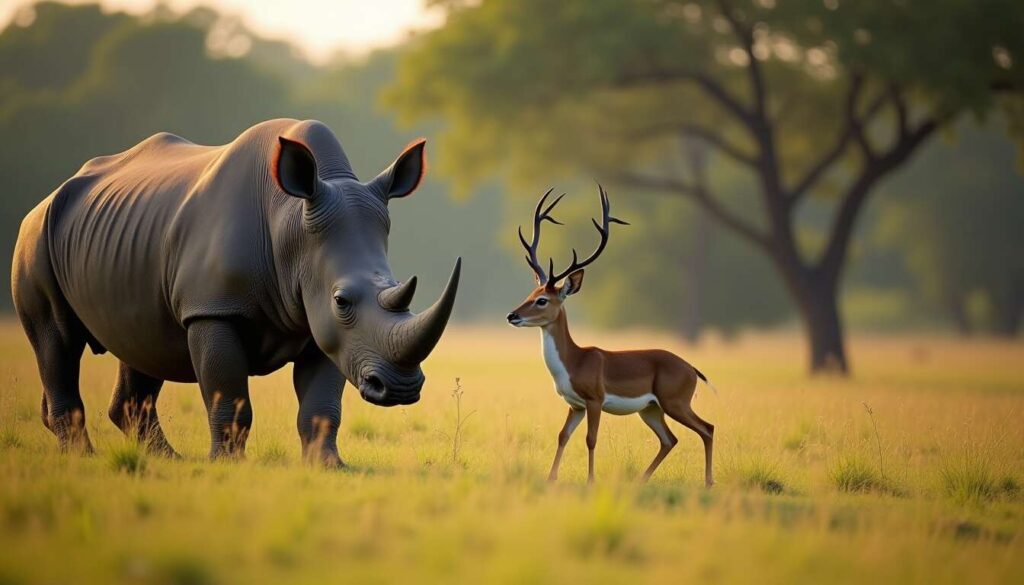
When wildlife encounters unfold in the wild, few scenarios capture the imagination quite like a confrontation between creatures of vastly different sizes. Recently, footage emerged of a diminutive deer species facing off against one of nature’s most formidable giants: a rhinoceros weighing approximately 1.7 tonnes. This extraordinary interaction highlights the unpredictable nature of animal behaviour and offers a fascinating glimpse into the dynamics of territorial disputes and survival instincts within shared ecosystems.
Meeting context
Location and circumstances of the encounter
The remarkable confrontation took place in a protected wildlife reserve where multiple species coexist within overlapping territories. Such reserves often create conditions where animals that might not typically interact find themselves in close proximity, particularly around water sources and feeding areas. The encounter occurred during daylight hours, allowing observers to witness the full sequence of events that unfolded between these mismatched opponents.
Species identification
The tiny deer involved in this encounter was identified as a chevrotain, also known as a mouse deer, one of the world’s smallest ungulate species. These creatures typically weigh between 2 to 5 kilograms and stand merely 30 centimetres tall at the shoulder. The rhinoceros, by contrast, was a white rhinoceros, a species known for its massive build and powerful presence in African grasslands.
Understanding the physical disparity between these animals sets the stage for examining why such an encounter might occur at all.
David versus Goliath: size difference
Comparative measurements
The sheer scale difference between these two animals defies typical predator-prey or competitive relationships found in nature. Consider the following comparison:
| Characteristic | Chevrotain (Mouse Deer) | White Rhinoceros |
|---|---|---|
| Weight | 2-5 kg | 1,700 kg |
| Height | 30 cm | 180 cm |
| Length | 45-75 cm | 370-400 cm |
Physical advantages and disadvantages
The rhinoceros possesses overwhelming physical advantages in terms of mass, strength, and defensive capabilities. Its thick skin acts as natural armour, whilst its formidable horn serves as both weapon and tool. The chevrotain, however, compensates for its lack of size with remarkable speed and manoeuvrability. Its compact frame allows for rapid directional changes and the ability to navigate through dense vegetation where larger animals cannot follow.
- Rhinoceros advantages: massive weight, thick protective skin, powerful horn, intimidating presence
- Chevrotain advantages: exceptional speed, agility, small profile, ability to hide in minimal cover
- Environmental factors: terrain type, vegetation density, proximity to escape routes
These contrasting attributes reveal how nature equips different species for survival, leading us to examine typical behaviours in their natural settings.
Animal behaviour in natural habitats
Territorial instincts
Both rhinoceroses and chevrotains exhibit territorial behaviours, though expressed differently based on their physical capabilities and ecological niches. Rhinoceroses mark territories through dung middens and urine spraying, defending areas that can span several square kilometres. Chevrotains maintain much smaller territories, relying on scent marking and vocalizations to communicate boundaries to others of their species.
Typical interaction patterns
Under normal circumstances, these species would simply avoid one another. The chevrotain’s natural inclination is to flee from potential threats, using its acute senses to detect danger well before visual contact occurs. Rhinoceroses, despite their poor eyesight, generally ignore smaller creatures that pose no threat to their resources or safety. The documented encounter therefore represents an anomaly in typical behavioural patterns.
Resource competition
Competition for resources occasionally forces unlikely confrontations. Both species require access to water, vegetation, and safe resting areas. During periods of drought or in areas with limited resources, animals may find themselves competing for the same vital elements, leading to unusual interactions.
With these behavioural patterns established, examining the rhinoceros’s capabilities provides crucial context for understanding the encounter.
The formidable power of the rhinoceros
Physical capabilities
The white rhinoceros represents one of nature’s most powerful land mammals. Despite weighing nearly two tonnes, these animals can reach speeds of 50 kilometres per hour when charging. Their horn, composed of keratin, can grow up to 150 centimetres in length and serves as a devastating weapon when deployed defensively or aggressively.
Defensive and offensive strategies
When threatened or agitated, rhinoceroses employ several intimidation tactics:
- Loud snorting and huffing to signal aggression
- Ground pawing and head swinging to demonstrate intent
- Mock charges to test threats and establish dominance
- Full-speed charges when genuinely threatened or protecting young
The psychological impact of a rhinoceros’s presence alone often suffices to deter potential conflicts. Few animals willingly engage with such a formidable opponent, making the chevrotain’s behaviour all the more remarkable.
Yet the smaller animal’s own capabilities deserve equal examination to understand how this confrontation unfolded.
The surprising agility of the tiny deer
Evolutionary adaptations
Chevrotains have evolved remarkable survival mechanisms over millions of years. Their small size, whilst appearing disadvantageous, actually provides significant benefits in densely vegetated environments. These animals can accelerate rapidly, reaching their top speed within seconds and changing direction with extraordinary precision. Their slender legs, though delicate in appearance, contain powerful muscles capable of generating impressive force relative to body mass.
Defensive tactics
When confronted by larger animals, chevrotains rely on a repertoire of evasive manoeuvres. They employ sudden zigzag patterns that confuse pursuers, leap into water to escape land-based threats, and freeze motionless when camouflage offers the best survival option. In this particular encounter, the chevrotain demonstrated unexpected boldness, potentially defending a nearby nest or young, or perhaps simply miscalculating the threat level.
The outcome of this extraordinary meeting reveals important lessons about wildlife interactions.
Reactions and consequences of the encounter
Observed outcomes
Witnesses reported that the confrontation lasted several minutes, with the chevrotain making aggressive postures despite the overwhelming size disadvantage. The rhinoceros, seemingly more confused than threatened, eventually moved away from the area, allowing the smaller animal to maintain its position. This outcome suggests that determination and territorial conviction can sometimes outweigh physical superiority in wildlife encounters.
Broader implications
This incident provides valuable insights for wildlife researchers studying animal behaviour and territorial dynamics. It demonstrates that predictable patterns do not always govern wildlife interactions and that individual temperament plays a significant role in determining outcomes. Conservation efforts benefit from understanding these nuanced behaviours, particularly when managing protected areas where multiple species coexist.
The encounter between a tiny chevrotain and a massive rhinoceros serves as a powerful reminder of nature’s complexity and unpredictability. Whilst physical size often determines dominance in the animal kingdom, factors such as motivation, territorial instinct, and individual courage can occasionally produce surprising results. This extraordinary confrontation highlights the importance of preserving diverse ecosystems where such remarkable interactions can occur naturally, offering continued opportunities for observation and understanding of the intricate relationships that define wildlife communities.